|
Many writers about film
have a mistaken notion of art. They think it presents experiences
packed with tight, compressed meaningfulness, just sitting there
waiting to be unpacked by the diligent critic. In the standard critical
demonstrations, the greatness of Citizen Kane, Vertigo,
or 2001 is that virtually every lighting effect, camera angle,
or prop is freighted with interlocking significance. Criticism is
the act of translating those stylistic details into an intricate
series of significations. The critic exhumes the sermons the artist
has artfully hidden under his stones. In this view, both creation
and interpretation are acts of mastery–Faustian enterprises in
which the artist operates from a position of ultimate knowingness
that the critic and viewer aspire to equal.
Of course, there are
films that are organized this way and yield to this kind of critical
scrutiny–Hitchcock's work leaps to mind as an extended example,
but that doesn't change the fact that it is a game-playing, puzzle-solving
notion of art, that could probably only have come to the fore in
a field as immature as film study. If we look at truly great works
of art we find something quite different. They are more likely to
be humble and tentative than displays of intellectual power and
knowledge. They are more likely to be acts of exploration than presentations
of compressed, prepackaged meaningfulness. Encountering them is
more likely to feel like living through an unusually complex and
demanding experience than like learning something.
To watch Uncle Vanya
is not to move through a world of hidden meanings waiting to be
decoded but to be exposed to psychological uncertainties and emotional
complexities that it is impossible to get to the bottom of. To stand
in front of Rembrandt's portraits is always to be at least somewhat
in the dark, uncertain about what you are seeing and what it means.
His figures just slightly elude understanding--his own as well as
ours. They won't snap into focus morally, psychologically, or semantically,
not just the first time, but the hundredth time we look into their
elusive eyes. To navigate Shakespeare's suspended, sliding clauses
with their multivalent, unresolved metaphoric associations is not
to be put in a position to excavate meanings hidden just under the
surface, but to undergo a series of experiences too shifting and
slippery to be pinned down as "meanings" or "knowledge."
What is normally denoted by words like knowledge, meaning,
and significance--something clear, definite, static, atemporal,
and abstract--is the very opposite of these artistic experiences.
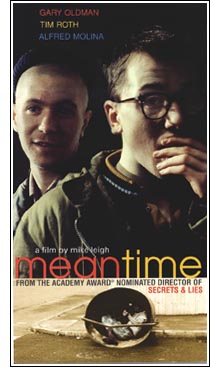 Meantime
shows what it feels like for a film to be a genuine act of exploration
for its creator, its actors, and its viewers. It is clear that Leigh and
his actors went into the film not quite knowing where they would come
out. The film takes the viewer on the same voyage of discovery that they
took in the process of making it. The difference in the way it was made
is why the characters and scenes don't offer a set of static, abstract
meanings to be decoded, but a sequence of flowing, shifting events to
be lived through. Meantime
shows what it feels like for a film to be a genuine act of exploration
for its creator, its actors, and its viewers. It is clear that Leigh and
his actors went into the film not quite knowing where they would come
out. The film takes the viewer on the same voyage of discovery that they
took in the process of making it. The difference in the way it was made
is why the characters and scenes don't offer a set of static, abstract
meanings to be decoded, but a sequence of flowing, shifting events to
be lived through.
Its general subject is
the relationship of two families headed by sisters. As Leigh often
does, he organizes the film around a series of contrasts based on
class and temperament. The premise is that the sisters' personalities
are as different as possible and they have married into entirely
different social and financial milieus at the opposite ends of the
spectrum. Barbara is childless, financially and socially successful,
lives with her businessman husband in a nice house in a suburban
neighborhood, has a refined voice and mannerisms, a cool demeanor,
and a fairly intellectual temperament. Mavis is irascible, blunt,
outspoken, somewhat inarticulate, loud, coarse, and poor, and lives
in public housing with a layabout husband and two twenty-something
sons (who are themselves set up to be opposites: Mark is clever,
sharp-tongued, and devious; Colin is quiet, meeker and mentally
slower). While the one couple is polite, deferential, and subdued
in its interactions, the other family bickers and squabbles more
or less continuously. The general situation was clearly chosen to
allow for the possibility of a number of dramatic comparisons and
contrasts dear to Leigh's heart (the "refined" and "coarse"
sisters, the "bright" and "dull" brothers, and
the manners and modes of expression of the upper-middle and lower-class
family members in general).
But beyond outlining
a dramatic situation with many potential contrasts, clashes, and
differences in points of view, it is clear that Leigh began, not
with a set of points to be made, but a series of questions to be
explored. For the one family, how might you act, talk, and feel
if you were unemployed and on the dole? For the other, how might
you act, talk, and feel if you were highly successful? For the socially
and financially flourishing family, how might you interact with
the less successful relatives? For the other family, how might you
treat relatives who are much better off? How might financial marginality
affect a father's relationship with his wife and grown sons, particularly
given the coarseness of all involved? How might you act if you were
in your early twenties and had nothing to look forward to in the
way of financial improvement of your situation? What is it like
to be a skinhead, a punk, a drifter? The questions are really endless
for an actor or director, since new ones keep coming up as you go
through a scene encounter by encounter and beat by beat. (If you
were the father on the dole, would you let your son mouth off to
you like that? What might you say in reply? What would your tone
of voice or gestures be? How might the son respond? What would be
your response to that?)
What makes the experience
challenging for a viewer is that Leigh doesn't confine the question
asking to himself and his cast. He wants the viewer to become an
explorer also. Most films make points and provide insights, not
require viewers to move through situations without them. While other
films simplify characters' personalities and interactions to facilitate
understanding, Leigh's scenes and characters resist thumbnail glosses
and delay judgments by presenting sensorily "thick" and
cognitively "unanalyzed" experiences. Experiences don't
come with handles to pick them up (in the form of a lighting effect,
a musical orchestration, or a narrative puzzle to be solved). And
their meaning keeps changing; the viewer is forced to keep revising
his interpretations of events and characters, adjusting his understanding
in the light of each new development. Instead of rushing to conclusions,
the viewer must simply stay open. Knowing must give way to wondering
and surmising.
If we ask which character's
perspective is the "correct" or "best" one,
which is "right," or who we are supposed to "believe"
or "identify with," we get nowhere. That would be to assume
that Leigh endorses the sort of superpersonal, absolute truth that
exists in most mainstream films. In Casablanca, Citizen
Kane, or Psycho, it is possible to attain a final, cumulative,
"correct" view that subsumes and includes the partial
views of the individual characters. There is an absolute, impersonal
truth to be arrived at, and in fact arriving at it might be said
to be the purpose of the narrative for the viewer. (The main character
almost always finally attains that "ideal" view in most
works–in Hitchcock's films, for example). But, even when no character
attains it (as is the case in Citizen Kane) the viewer does.
As the ending of Kane grandiloquently illustrates, no matter
how fragmented the temporal presentation and how halting the progress,
the ultimate possibility of a general, comprehensive understanding
is never really in question. Though the moral of Kane is
sometimes said to be the opposite, it is clear that it tells us
that there is a truth beyond individual biases.
Leigh simply doesn't
believe in truth in general. In his work, there is no getting beyond
truth's perspectival nature. In Emily Dickinson's term, all truth
is "slant;" none is straight. The individual views of
Mark, Barbara, Colin, and Haley do not cumulate in a general, comprehensive
overview, any more than those of Peter, Norman, Sylvia, and Hilda
do because a general, impersonal understanding is an impossibility.
Barbara's understanding
of what she is doing, Mark is doing, and Colin is doing is fundamentally
different from Mark's or Colin's understanding of it and her. All
three perspectives are equally right–and equally limited. All three
are equally correct–and equally biased and partial. Each person
has his own truth, based on who he is, what he has lived through,
and what he brings to the particular moment. The film itself is
the closest we can get to an understanding of the whole truth–an
understanding that is irreducibly perspectival.
Even considering his
characters individually, Leigh won't filter their personalities
and interactions to purify their effect and function. Everyone's
motives, goals, intentions are mixed and impure. American movies
tend to see their characters in terms of moral and emotional absolutes:
This one is good and that one bad; this one an idealist, that one
a cynic; this one a hero, that one a villain. In Leigh, no one is
simply right or wrong–no one is simply anything. Everyone is many
different, contradictory things.
In Bleak Moments,
Sylvia is funny and loving (and deserves love and affection),
but she is also intimidating to men, unpredictable, perverse, and
self-defeating; Peter is a prig, but a sincere, well-meaning one.
In The Kiss of Death, Trevor is refreshingly free and spontaneous,
but also self-centered, irresponsible, and immature. In Meantime,
Barbara is kind but also deeply flawed; Mark is cynical, negative,
and cruel, but can also be thoughtful, intelligent, and right about
some things; Colin is trusting and innocent, but also flawed in
some respects. We want black and white, but Leigh gives us gray.
We want a hero to cheer for and identify with, and a villain to
dislike; but Leigh gives us prickly, strange, mixed (and mixed-up)
figures.
Leigh won't "cheat"
to make a point. He won't exaggerate the characters' qualities to
make things easier on the viewer. Turn on almost any American film
and you'll find a main character you can admire, a "good"
figure (who is able to be so good because his problems are outside
himself), whose consciousness the viewer can flatteringly "become."
No character is that simple or pure in Leigh's work. Heroism is
imperfect (which is why the concept doesn't really apply). Virtue
is flawed. Good intentions are expressed in troubling or mixed-up
ways. Wendy, in Life Is Sweet, is as good a character as
Leigh ever creates, but she is also a bit of a nag and a ditz. American
film viewers feel frustrated by this state of affairs. Everyone
seems stupid or inadequate in some way. Is Leigh mocking all of
his characters? Is he cynical or despairing? Surely, we are not
meant to "admire" Mark, Colin, Barbara? And the answer
is no, we are not. But the imperfection of these figures is not
a flaw or miscalculation on Leigh's part. Nor an expression of cynicism.
It is his deeply humane appreciation of his characters' humanity.
It represents his understanding that, in Lenny Bruce's phrase, truth
is not what should be, but what is. In fact, if anyone deserves
to be accused of despair or cynicism, it is the Hollywood filmmakers
who feel that they have to idealize characters to make them valuable.
Leigh respects and honors figures who are like the ones we meet
in life–who are like us, with flaws, shortcomings, and every other
kind of compromise. For Leigh, reality doesn't have to be prettified
or simplified to merit our interest; what is, is good enough....
–Excerpted from Ray
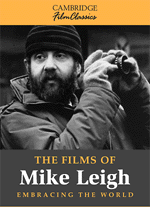
Carney, The Films of Mike Leigh: Embracing the World (London
and New York: Cambridge University Press, 2000).
To read more about
critical fashions, see the essay "Sargent and Criticism"
in the Paintings section, "Capra and Criticism"
in the Frank Capra section, and "Skepticism and Faith,"
"Irony and Truth," "Looking without Seeing,"
"Art as a Way of Knowing," and other pieces in the Academic
Animadversions section.
 |
 |
Ray
Carney's The Films of Mike Leigh is quite simply the
best book of film criticism I have ever read.
Now I have to say
that I have never read any of Carney's other books (he has
also written books on Cassavetes, Frank Capra, and Carl Dreyer),
which, for all I know, might be even better. But as a friend
of mine put it, 'His writing blows everything else out there
away, even to the point of many times seeming like simply
in a class of his own...different in kind more than degree.'
And although I admit to not having read 'everything else out
there,' I feel the exact same way. Ray Carney's new book has
undeniably rocked my world.
Ray Carney's book
is to what usually passes for film criticism what Mike Leigh's
movies are to what, in Hollywood, usually passes for filmmaking:
a truly radical critique, a whole different animal, and a
solitary voice of sanity that has somehow miraculously managed
to make itself heard over the noise and hullabaloo of this
culture's present-day insanity. |
|
–Caveh
Zahedi, creator of A Little Stiff and I Don't Hate
Las
Vegas Anymore,
in a review in Filmmaker Magazine |
| |
|
| |
Mike Leigh’s work is difficult to pin down. Echoing what Ray Carney says of Leigh’s more blinkered characters, examining these films becomes a lot murkier when you bring too many ideas and film-critical categories to bear. Although not without its strengths and serendipities, Garry Watson’s book suffers from intellectual larding while, like one of Leigh’s more far-sighted characters, Carney and Quart’s gets in amongst the rough-and-tumble....
The Carney and Quart book was the first critical study of Leigh’s work and every subsequent book on Leigh must negotiate its rigor and insight. I have yet to read a book that better approximates my experience of watching Leigh’s films.My one regret is that, apart from the important BBC plays Nuts in May and Abigail’s Party (1977), I have yet to see many of the early works wherein Carney locates the wellspring of Leigh’s improvisatory power and vision.
Animating this study is a distinction between two types
of Leigh characters that resonates culturally, politically and
spiritually across his work. For Carney, there are those like
Rupert and Laetitia Boothe-Braine in High Hopes (1988),
Nicola in Life Is Sweet (1990), and Sebastian in Naked (1993)
who, mired in a mental image of themselves, pigeon-hole
others in prejudices, effectively foreclosing on generous and
responsive solidarity. Then there are those like Cyril and
Shirley in High Hopes, Wendy in Life Is Sweet, and Louise in Naked who have all the foibles, strengths, and self-doubts of
their humanity, and are open to the flows of human interaction.
Alison Steadman’s giggly and affectionate Wendy still
epitomizes the principle of social cohesion in Leigh. It is perhaps
unsurprising that Steadman and Leigh were married,
while the positive response to the density of experience recalls
the thick descriptive methodology through which a Leigh
film is arrived at. Evoking the Dickensian and Lawrentian
views of human sensibility (as Watson points out), Leigh feels
that the individual mindset has consequences for the wider
culture, and by this light the generous impulse in Wendy and
other Leigh characters has been eroded by consumerism and
social mobility in postwar Britain. Not as overtly political as
Ken Loach, Leigh has nevertheless chronicled the domestic
consequences of the decline of the social consensus imagined
by writers from Dickens to George Orwell.
One of the most unexpected aspects of Carney and Quart’s book is the way it puts mainstream American cinema in perspective by comparing it with Leigh’s cinema.With his focus on characters as mannered and tic-ridden “outsides” (as opposed to Hollywood’s granting us access to Forrest Gump’s inner kindness despite the goofy exterior), Leigh charts that elusive quality, the “ordinary” moment—the everyday drama of interaction they never show in Hollywood because it occurs between the heroics.
In doing so, Carney shows, Leigh pulls apart the Enlightenment model of agency and volition on which most American movies depend. Recalling classes he has taught—he is Director of Film Studies at Boston University—Carney describes how Americans are often perplexed by a cinema in which nothing seems to happen. But Leigh’s drama of transformation is rooted in the layered rehearsal of interpersonal dynamics observed with the patience of a European Ozu. Whilst British Leigh commentators have been preoccupied with the writer-director’s purchase on the sociological landscape, Carney convinces us that Leigh and Ozu share a feeling for the interplay of performance and mise-en-scène which moves beyond David Bordwell’s pioneering Ozu dichotomy between modernism and tradition. Leigh’s conception of experience (unlike that of Hollywood) is durational rather than deadlined, heterogeneous rather than hurried. Carney’s examination of space and time in Leigh reveals, as Bordwell has done elsewhere, that the mainstream model of experience conceals as much as it reveals.... |
| |
–Richard Armstrong, a review of Gary Watson, The Cinema of Mike Leigh and Ray Carney and Leonard Quart, The Films of Mike Leigh: Embracing the World, published in Film Quarterly, Dec 2005, Vol. 59, No. 2, pp. 62-63 |
| |
|
| |
No other study sheds such a revealing light on Leigh's background, his influences, his emotional groundings, and, of course, his unique cinematic sensibility....[Carney's The Films of Mike Leigh is a] powerful and multifaceted analysis which welcomes, like Leigh's work, the vibrant eye and the uncalcified consciousness.
|
| |
-- Andrew Hamlin, in a review of Ray Carney's The Films of Mike Leigh: Embracing the World, published in MovieMaker Magazine. |
| To learn
how to obtain this book, click
here |
|