Victor Manfredi — writing
The selected texts, at various degrees of publication, are posted in .pdf format unless otherwise noted. Critiques are invited, especially data corrections, in addition to the ones already posted here in the supplementary comments.
Philological boilerplate plus Unicode crib sheetÀjàyí Crowther's orthographic subdot, adopted in 1851 to signify the systematic phonetic feature [+ narrow pharynx] — better known after Chomsky & Halle (1968) as [‑ATR] — is an essential piece of tech for tens of millions of 9ja literates. In principle, it can be digitally rendered as the Unicode glyph U+0329 ("combining vertical line below" = HTML "& # 8 0 9 ;" (without the wordspaces), or alternatively as U+0323 ("combining dot below") = HTML "& # 8 0 3 ;" (without the wordspaces), but in practice this patch leaves a lot to be desired. For one thing, not all browsers display the subdot, so some readers of this page will see nothing under the first two vowels of É̩hu̩gbò. For another, the kerning (horizontal alignment) of this kludge is chaotic, especially in book‑quality faces in sizes above 8 pt. Even in certain typefaces wishfully called "Unicode compliant", legibility is woeful as can be verified by inspection of the enclosed test page, which was prepared at random. Real published examples can be much worse. This train wreck should matter even to Unicode apologists who hide behind the race-to-the-bottom rampart of "bare legibility in plain text". Third and most devastating for an aspiring information commons — an admittedly quaintly utopian notion in the present day of privatized Orwellian-corporate internet — is the effective kneecapping of unambiguous searchability, a function that currently depends on an unuseable hack called "Unicode normalization". Such defects of the combining subdot notwithstanding, "[p]recomposed [and simultaneously subdotted] accented characters for Yorùbá were rejected from Unicode" (Filip Blažek), but why exactly? By which calculus and with what legitimacy was it decided to deprecate the goal of mass literacy in tropical Africa below, say, the frantic minting of infinite emoji code points for the brave new mass distraction autosurveillance economy more aptly termed "antisocial media"? (Maybe when the complete crosscultural inventory of gestures is exhausted — in all possible skintones, of course — perhaps Unicode then will find the time and bandwidth to address basic African spelling?) Polite inquiries to The Unicode Consortium about this unsatisfactory status quo were replied (email of M.D., 25 September 2008, available on request) with a smooth blend of bureaucratic indifference ("The disclaimer you mentionned [sic] in your email *is* absolute, and these combinations will not be encoded, so you should not waste your time making a proposal for them") and lazy palming off of the problem to apocalyptic and politically radioactive SIL/WBT missionaries, who are presumed to 'own' subdotted roman scripts, maybe based on an implied metaphysical 'ownership' of the speakers of the respective languages: "Those look fine with a font like Doulos SIL that can handle them". Funny enough, δοῦλος/doulos is New Testament Greek for 'slave'—the script kiddies at Camp Wisdom must have been dreaming of Doktor Freud when they named their Africanist digital type. Such self-outing nightmares aside, anyone who thinks that pentacostal interventions are harmless has not observed the condition of civil society in evangelized West Africa of recent decades. This typographic nicety nicely illustrates how priorities are set, who benefits and so on, under globalized neoliberalism. Not to excuse the Abuja ruling elite, who could have taken a benevolent interest in the problem, whereas the opposite has been the case. For example, in late 2006 while preoccupied with funding the PDP's 2007 auto‑succession campaign, the ò̩gá‑at‑the‑top General Káńkpé experienced a fit of pique at the second executive director of the National Institute for Nigerian Languages, who had failed to parse the plain meaning of the expression o̩mo̩lúwàbí percentage, so the general "ordered its scrap and stoppage of its budgetary allocations" (Wakili 2012, cf. Aziza 2011 and emails of A.A. and O.E., 19 January and 3 September 2007; note that the euphemism for ministerial kickbacks (sc. kickfronts) continues to evolve, e.g. "Chúkwu said because he was not carried along, he would not release the money under his ministry" (Oyèébádé & Gyamfi 2014, emphasis added).Aziza, R. [2011]. Nigerian languages teaching and usage; problems and prospects. Ms., Department of Languages & Linguistics, Delta State University, Abraka.
Oyèébádé, 'W. & C. Gyamfi. [2014]. My battle with prostate cancer, by 'Wo̩lé S̩óyín̄ká; Nobel laureate, others urge govt to release N400m for centre. Guardian (Lagos), 25 November.
Wakili, I. [2012]. Senate Opposes Scrap of Languages Institute. Daily Trust (Abuja), 5 July.
[Update 6 April 2017] Stray signs from 2015 suggest that generalissimo O̩básanjó̩'s 2006 revenge gambit to dash NINLAN to Ǹsú̩ká eventually collapsed — an outcome that did not need a díbi̩à áfá to foretell, given the condition of the 200 km. of federal roads separating Wáàwa Land from Ńgh̩wà Land in the Oriental Province of 9ja! Apparently in the less longthroated (post-PDP) era, Prof. Elugbe was recalled to resume his occupātus interruptus and resurrect the àbíkú/ògbáńje institute as "an Inter-University Centre for Nigerian Language Studies" (references below, archived here). No hint of this yet at Nigerian Universities Commission but è̩gbó̩n professor, maybe NINLAN can haz website soon?
Adbot. [2015]. National Institute for Nigerian Languages (NINLAN) Recruitment 2015. Automated job listing.
Ùmé[h], K. [2015]. NINLAN to award degrees. NINLAN to award degrees, Guardian (Lagos), 2 July.
[Update 15 October 2024] The NINLAN cadaver is ripe for another episodic àbíkú rebirth and contract-milking, this time by the T-pain régime:
A project to accommodate the subdot and other Nigeriana in typewriters, letterpress and desktop publishing took shape in 1983 with support from the Federal Ministry of Education in Lagos and from Hermann Zapf (cf. Hermann Zapf, ein Arbeitsbericht. Maximilian‑Gesellschaft Hamburg 1984, p. 82. ISBN 3921743281). Like other nationalist efforts, PanNigerian vanished into "the chaotic complex" when the appropriation vortex shifted to Babangidan Abuja (cf. O. Láwúyì, "Understanding the Nigerian state; popular culture and the struggle for meaning", The Transformation of Nigeria; essays in Honour of 'Tóyìn Fálọ́lá, edited by A. Oyèbádé, 511‑30. Africa World Press, Trenton New Jersey, ISBN 0865439982). Current hopes rest on civil society efforts like Lagos Analysis Corporation Technologies and African Languages Technology Initiative (Ìbàdàn).Daily Trust. [2024]. Reps seek establishment of Bola Ahmed Tinubu University, Daily Trust (Abuja), 12 October.
[NOTE: Technically savvier discussion of these points, plus more doctrinal pushback from Unicode defenders, appeared on Language Log shortly after my own hapless collision with the planet's typographic authorities. See also this forthright critique, cited as an undated update by Language Log:"After the intervention of the Greek national authorities, the Unicode organization abandoned the composite approach for Greek and replaced it with the precomposite approach that had long before been universally adopted for Latin-alphabet varieties such as French, Spanish or Czech. …[C]omposite characters are aesthetically unacceptable and lead to technically unpredictable data. They are therefore in direct conflict with the aims of the International Standards Organization."Maybe we need to update Max Weinreich's immortal wisecrack about glossopolitics to something like "A language is a dialect with precomposed/precomposite diacritics."]
Mueller, G. [2006]. Why Nanos uses precomposite Greek characters in preference over composite ones.
www.e-ternals.com/nanos/data.htmThanks to the clout of Vietnamese and romanized Indic languages in corporate software's higher echelons, an integrated (precomposed), therefore correctly aligned and (we can hope) unambiguously searchable subdot has been made available for upper and lower roman vowels and s. This resource accidentally represents real progress for any users of 9ja orthographies who choose not to mark tone, or even for those who are prepared to play the lottery of combining tonemark alignment. Here are the Unicode and HTML (remove wordspaces) bit addresses for the subdotted letters most commonly used in 9ja orthographies, and for the nonintegrated but nonspacing (i.e. possibly "combining") acute and grave accents as well as the less important macron, plus a more fully descriptive link for each:U + 1 E A 1 = & # 7 8 4 1 ; = LATIN SMALL LETTER A WITH DOT BELOW
U + 1 E B 9 = & # 7 8 6 5 ; = LATIN SMALL LETTER E WITH DOT BELOW
U + 1 E C B = & # 7 8 8 3 ; = LATIN SMALL LETTER I WITH DOT BELOW
U + 1 E C D = & # 7 8 8 5 ; = LATIN SMALL LETTER O WITH DOT BELOW
U + 1 E E 5 = & # 7 9 0 9 ; = LATIN SMALL LETTER U WITH DOT BELOW
U + 1 E 6 3 = & # 7 7 7 9 ; = LATIN SMALL LETTER S WITH DOT BELOW
U + 1 E A 0 = & # 7 8 4 0 ; = LATIN CAPITAL LETTER A WITH DOT BELOW
U + 1 E B 8 = & # 7 8 6 4 ; = LATIN CAPITAL LETTER E WITH DOT BELOW
U + 1 E C A = & # 7 8 8 2 ; = LATIN CAPITAL LETTER I WITH DOT BELOW
U + 1 E C C = & # 7 8 8 4 ; = LATIN CAPITAL LETTER O WITH DOT BELOW
U + 1 E E 4 = & # 7 9 0 8 ; = LATIN CAPITAL LETTER U WITH DOT BELOW
U + 1 E 6 2 = & # 7 7 7 8 ; = LATIN CAPITAL LETTER S WITH DOT BELOW
U + 0 3 0 1 = & # 7 6 9 ; = COMBINING ACUTE ACCENT
U + 0 3 0 0 = & # 7 6 8 ; = COMBINING GRAVE ACCENT
U + 0 3 0 4 = & # 7 7 2 ; = COMBINING MACRON
Unfortunately the "combining" superscript accents are just as blunt an instrument as the "combining" subdot, so it would still be more reasonable for the wise bosses of Unicode to kindly provide precomposed subdots for all of the five roman vowels upper and lower case EVEN WHEN THESE VOWELS ALSO BEAR PRECOMPOSED ACUTE AND GRAVE ACCENTS. But until that glory day arrives, southern 9ja literates will be forced to choose their poison: either to tweak the alignment of the combining subdot, or that of the acute and grave accents. At least, thank goddisses, there's no need to drink both poisons at the same time; instead, the prudent 9ja typist will ensure that either the subdot or the accent is used in the composed or integrated (not the "combining") form. A fortiori, the "combining" superscript accents should emphatically not be used with plain (non‑subdotted) vowels or tonebearing nasals for which composed/integrated tonemarks exist (see complete list below). Some text editors are programmed to automatically substitute the respective composed/integrated character for the sequence of letter plus combining diacritic, but it would be naive to trust this to happen on any given day. Apple's tablet‑like OS10.8 (enervatingly named after yet another cat species — can Civettictis civetta be next?) is the worst of both worlds: all the illegibility of combining characters, wrapped in a pseudo‑composed display format so that diacritics can't be tweaked.U + 0 0 E 1 = & # 2 2 5 ; = LATIN SMALL LETTER A WITH ACUTE
U + 0 0 E 0 = & # 2 2 4 ; = LATIN SMALL LETTER A WITH GRAVE
U + 0 0 E 9 = & # 2 3 3 ; = LATIN SMALL LETTER E WITH ACUTE
U + 0 0 E 8 = & # 2 3 2 ; = LATIN SMALL LETTER E WITH GRAVE
U + 0 0 E D = & # 2 3 7 ; = LATIN SMALL LETTER I WITH ACUTE
U + 0 0 E C = & # 2 3 6 ; = LATIN SMALL LETTER I WITH GRAVE
U + 0 0 F 3 = & # 2 4 3 ; = LATIN SMALL LETTER O WITH ACUTE
U + 0 0 F 2 = & # 2 4 2 ; = LATIN SMALL LETTER O WITH GRAVE
U + 0 0 F A = & # 2 5 0 ; = LATIN SMALL LETTER U WITH ACUTE
U + 0 0 F 9 = & # 2 4 9 ; = LATIN SMALL LETTER U WITH GRAVE
U + 0 0 C 1 = & # 1 9 3 ; = LATIN CAPITAL LETTER A WITH ACUTE
U + 0 0 C 0 = & # 1 9 2 ; = LATIN CAPITAL LETTER A WITH GRAVE
U + 0 0 C 9 = & # 2 0 1 ; = LATIN CAPITAL LETTER E WITH ACUTE
U + 0 0 C 8 = & # 2 0 0 ; = LATIN CAPITAL LETTER E WITH GRAVE
U + 0 0 C D = & # 2 0 5 ; = LATIN CAPITAL LETTER I WITH ACUTE
U + 0 0 C C = & # 2 0 4 ; = LATIN CAPITAL LETTER I WITH GRAVE
U + 0 0 D 3 = & # 2 1 1 ; = LATIN CAPITAL LETTER O WITH ACUTE
U + 0 0 D 2 = & # 2 1 0 ; = LATIN CAPITAL LETTER O WITH GRAVE
U + 0 0 D A = & # 2 1 8 ; = LATIN CAPITAL LETTER U WITH ACUTE
U + 0 0 D 9 = & # 2 1 7 ; = LATIN CAPITAL LETTER U WITH GRAVE
U + 1 E 3 F = & # 7 7 4 3 ; = LATIN SMALL LETTER M WITH ACUTE
U + 0 1 4 4 = & # 3 2 4 ; = LATIN SMALL LETTER N WITH ACUTE
U + 0 1 F 9 = & # 5 0 5 ; = LATIN SMALL LETTER N WITH GRAVE
U + 0 E 3 E = & # 7 7 4 2 ; = LATIN CAPITAL LETTER M WITH ACUTE
U + 0 1 4 3 = & # 3 2 3 ; = LATIN CAPITAL LETTER N WITH ACUTE
U + 0 1 F 8 = & # 5 0 4 ; = LATIN CAPITAL LETTER N WITH GRAVEBy whatever means tones manage to be typed, the tonemarks given here for any of the Benue‑Kwa (BK) languages follow a dual convention, consistent with best practice known to me although not necessarily matching current popular or official usage — fully explicit tonemarking being rare outside of Yorùbá. Throughout BK, [ ́ ] = high, [ ̀ ] = low, but marking differs in a principled way between the BK1 and BK2 subgroups correlated to prosodic type as discussed in Manfredi (2009a). For clarity, the pitch labels H, M, L and ! (downstep juncture) are added parenthetically. In BK2 (comprising the Gbè, Yorùbá, Nupe and Ìdọmà macro‑clusters) with 3 lexical tones, marking economy is paradigmatic i.e. syllable‑by‑syllable, thus no mark = mid, but in BK1 (the historic remnant including Àkan, Ẹ̀dó, Ìgbo, Tiv, "Bantu" &c.) with only 2 lexical tones, marking economy is syntagmatic, thus no mark = same as preceding and a sequence of two high marks = downstep starting on the second (Welmers & Welmers 1968, cf. Christaller 1875, Nwáchukwu 1995), e.g. Ẹ̀dó Ólokún (HH!H) '[tutelary supernatural, from Yorùbá]'. Furthermore, following Bám̄gbóṣé (1966) and Ámayo (1976), downstep preceding nonhigh is marked by a word‑internal period, e.g. Yorùbá Oló.kun (MH!M) 'possessor/epitomē/personfication of òkun (LM) [the ocean]' vs. Olókun (MHM) 'possessor/epitomē/personfication of okun (MM) [energy]' and the same expedient conveniently generalizes to a non‑spreading juncture between high and a following low, e.g. Yorùbá oló.dù (MH!L) 'possessor/epitomē/personfication of an òdù (LL) [clay cauldron]' vs. olódù (MHL) 'possessor/epitomē/personfication of an odù (ML) [8‑bit oracle sign]', cf. also Ẹ̀dó nó.dè̩ (H!L) 'yesterday'.[Update 4 November 2021] After further indignant complaints directed by email to "higher" instances, a Unicode mafioso/ológbòóni sent a detailed reply (available on request) which though unofficial is undeniably informed with deep technical knowledge, whatever it may still lack in selfawareness of the sociology of knowledge and the political economy of digital capital. On the plus side, our correspondent does supply a few missing fragments of the broken Unicode story which I take the liberty to share below, adding obvious objections which like all sceptical responses to religious dogmata will remain substantively unanswered per saecula saeculōrum:
(i) "Unicode has a concept of 'Combining Character Class'… Diacritics below a base character should always precede diacritics above, regardless of how they are input. Normalization Form C, which is also defined by Unicode and should be done by any database system, provides that" in the Nigerian case, either the precomposed (Vietnamese) subdot or at worst the wretchedly "combining" subdot should precede a superscript tonemark. Translation: if the alphabetic planet is condemned to coding hell, there's an approved way to get there. But who even knew this? I've been hacking away at the problem alongside other civic-minded amateurs for decades and this is the first time any Uni-maven ever clued me to this rule. What are the chances that street-level users will guess the mystic combination, far less apply it consistently in practice across ever-changing proprietary platforms? And WITHOUT magically conforming to Normalization C, what hope of treating coded characters as clean data. This failure seems to defeat the datamining business model, unless of course they've already written off Niger-Congo or handed it off to the "SIL" (see below).(ii) "SIL's font makers and IT specialists are not missionaries (except by accident). Doulos SIL (new name) does indeed handle ẹ́ correctly as far as kerning is concerned, given a proper underlying OS." If the SIL is not a missionary enterprise then "der Herrgott" is indeed "boshaft" (in the words of Albert Einstein) and even so, the plain meaning of "doulos" is still slave, so inquiring minds still want to know who decided that African literacy should be pwned by a privately held trollfarm of rightwing "spiritual warfare"? Instead of which, Unicode's omni-scient, -present and -potent deities could just wake up one day and decide to liberate the best part of a continent by creating sixteen measly code points: subdotted u&lc roman e, i, o and u with precomposed acute and grave. Fīat odù mẹ́rìndínlógún!(iii) "[T]he Church is an absolute monarchy (under God), whereas Unicode is determined by a consortium of companies and some governments plus an ISO working group representing governments." A distinction without a difference kimosabe, but thanks for the free theology lesson. As for "governments" and "pre-existing national character sets", this is not a simple matter that can be left to unsupervised googool-ing cubicle geeks (see below).(iv) "XCCS, a Xerox standard that is the direct ancestor of Unicode, had no precombined characters at all. The precombined characters that were added were solely to provide 1:1 conversion between pre-existing national character sets and Unicode 2.0, which is why Vietnamese has a direct mapping between Unicode and national standards and African languages do not." Aha, now we're getting somewhere dottore. So who the dickens was the Xerox drone tasked to survey "pre-existing national character sets"? I put my hand on fire that Nigeria had already established such sets since the 1960's (if not the 1860's when it was just a glint in George Goldie's golden monocle), so if some distracted Silicon Valley flunky managed to miss this, whose fault is that na? No can rectify? I concede to no one in upbraiding dysfunctional federal Nigerian bureaucrats and autocrats for serially failing the cause of national languages (see tragicomical anecdotes above) but it's not as if the universities of the Global North lacked a knowledge base of how Nigerian languages are officially written. Libraries, dear chap, and U.S. Title VI-funded area-studies centers. Evidently it was cheaper to hand over the lion's share of African literacy to self-elected saviors who predictably served (saved) themselves, then the rest all'inferno.(v) "Unicode is, as I said above, simply the wrong target for such pressure, and they get a lot of it, so they tend to reply in brief, which is perceived as curtness." And wilful incomprehension is less painful to absorb in small doses.
1978Foreword to Kryad Poems by D. Abdell, 4-12. Chelsea Press, Chelsea Mass.
1982
1983Nigeria: Corruption in Development; the 1982 Proceedings of the Nigerian Anthropological & Sociological Assocation, held in Zaria, 10-13 May, edited by F. Ọdé̩kúnlé, 281-89. Ìbàdàn University Press.
My dissertation, chaired by S.J. Tambiah, with Ken Hale as the Harvard‑external committee member, and Susumu Kuno and Sally Falk Moore as the other Harvard members. Compact edition [400 pp. 8.5 x 11 inches].
No photos were included, but a few representative ones from the fieldwork years (1976‑77, 1980‑84) are posted on the research page — where can also be found links to the 90 minutes of audio originally distributed together with the thesis as a cassette tape.
Four sections of this work were published in essentially identical form (not separately posted on this page, but offprints are available on request).
Pp. 30‑33 together with 46‑61 had previously appeared as "Igboid"
The Niger‑Congo Languages, edited by J. Bendor‑Samuel, 337‑58.
University Press of America, Lanham, Maryland, 1989. ISBN 0819173762.
Pp. 61‑93 appeared as "Spreading and downstep; prosodic government in tone languages"
The Phonology of Tone; the Representation of Tonal Register, edited by H. v.d. Hulst & K. Snider, 133‑84.
De Gruyter, Berlin, 1993. ISBN 3110136058.
Pp. 182‑84 appeared as part of "Aspect, V-movement and V-incorporation in Àbe̩"
Studies in Generative Approaches to Aspect, edited by C. Tenny, 85‑95.
Lexicon Project Working Papers 24, July 1988. Center for Cognitive Science, M.I.T., Cambridge, Mass.
Pp. 188‑220 appeared as "Verb focus in the typology of Kwa/Kru and Haitian"
Focus & Grammatical Relations in Creole Languages, edited by F. Byrne & D. Winford, 3‑51.
Benjamins, Amsterdam, 1993. ISBN 1556191669.
Pp. 220‑41 had previously appeared as "Antilogophoricity as domain extension in Ìgbo and Yorùbá"
Niger‑Congo Syntax & Semantics 1, 97‑113.
African Studies Center, Boston University, 1987.JolanPanNigerian, the 20 year old PostScript face created in order to accommodate Nigerian orthographies (see p. 396 for details), looks grizzly on the screen but prints out smoother. (Not only people get grizzled with age — a consoling thought!)
As to content, much of the document de travail has been superceded in recent years, especially due to two steps which I took in response to the intractable mysteries faced by more standard kinds of analysis: (i) a shift from the autosegmental‑metrical hybridity of Chapter 1, to toneme‑free metrics (also here); and (ii) a move from the projected lexical conceptual structures of Chapter 2, to compositional lexical syntax (also here and here). In the interim I've also (iii) backed off of the strong WYSIWYG morphology conjecture of Chapter 3, to settle for an indispensable minimum of overt structural cueing, consistent with parametric, derivational phases (here) and irreducible to Distributed Morphology — a style of hyper‑ or meta‑phonology cum recapitulation of syntactic "debris" (Halle & Calabrese p.c.). All these changes were prefigured in the 1991 text, but not so for (iv) "scopophobia", a principle of syntax‑semantics mapping — Chapter 3 scrupulously avoided QR but offered nothing in its place apart from appeals to intelligent pragmatics. My current interest is (v) to combine the foregoing claims in order to treat focus phenomena without cartographic/criterial feature checking (here and here), and in order to capture subject/object and argument/adjunct asymmetry in wh‑dependencies.
My best luck came at the start of the journey, to compare Ìgbo and Yorùbá while learning about each from eminent southern Nigerian scholars and traditional verbal artists. That happenstance was somehow inevitable for an alárìnso̩ (the efficient translation into Yorùbá, applied to me by my ASUU sister Dr. Yétúndé Olúwafisàn, of the concept of 'peripatetic linguist with theatrical and mendicant airs') working in the then‑thriving federal university system at a time of cheap and safe public transportation. Under such conditions, the comparative window opened wide enough to show one nontrivial difference in the relation between sound and meaning. The agenda of topics could have been shorter, though my committee kindly refrained from pointing out this fact. My revered colleague Dr. Frannie Oyèébádé gave me friendly grief about the book's polymathic title, but from my outsider's standpoint I can't imagine engaging with these languages to the needed extent without facing what Chomsky calls Orwell's Problem. Maybe a grammarian can untangle puzzles of ideology and demography in the cognitive science vein (cf. Wallerstein quoted here).
My worst typo is the omission of Kay Williamson's name from the Acknowledgements (p. 13), although her generous mentorship is writ throughout. She was too polite to mention my mistake; when a third party pointed it out in 1994, she gracefully accepted that no vendetta was behind the lapse.
The issues raised in veiled terms in section 4.7 ("The poverty of Africanist philology" pp. 309-11) have been discussed more overtly and in much more detail by B. Lawal, "À yà gbó, à yà tó—new perspectives on e̩dan Ògbóni" (African Arts 28.1, 36-49, 98-100).Tone correction: LHL tones printed on the language name "Igala" on pp. 24 (fn. 15) and 31, due to Banfield (1914, 178) and Armstrong (1965, 78), are probably a prosodic anglicism reinforced by irresistible Yorùbá priming (e.g. Bám̅gbós̩é 1986, 42). Ìlò̩rí (2009) gives the name with MHL, but that's a likely Yorùbáism, because two independent citations by speakers give initial H while explicitly mentioning the restriction that "[t]here is no noun in Ígálâ that begins with the mid tone" (Ètù & Mìáchî 1991, 7, cf. Ọmachonu 2012, 22), contrasted with the fact that Standard Yorùbá strictly prohibits H on initial onsetless syllables in open-class lexical items (Ward 1952, 37). Prosodic anglicization is rampant in proper names all over West Africa, e.g."Í ì g b o" HLL for Ìgbo LL [= colonial "Ibo"]
"Ọ̀ n ị́ ị̀ c h a" LHLL for Ọ̀nịcha LLL [= colonial "Onitsha"]
"À k á n" LH for Àkan LL
and so on. For the third of these I followed Christaller (1875, x, xvi in this paper but now provisionally write the LL version until otherwise enlightened. And here's one more "Igala" confusion in public record: WorldCat's entry for Ètù & Mìáchî's school text mistypes the medial vowel of the language name as [i], but in fact the authors write it consistently as [a].
Armstrong, R. [1965]. Comparative wordlists of two dialects of Yoruba with Igala. Journal of West African Languages 2, 51‑78.
Bám̅gbós̩é, A. [1986]. Yorùbá, a Language in Transition. J.F. O̩dúnjo̩ Lecture 1. Yába, Lagos.
Banfield, A. [1914]. Dictionary of the Nupe Language. Niger Press, Shonga.
Ètù, Y. & T. Mìáchî. [1991]. Ígálâ ékọ́chẹ, Ọ̀tákáda ejódùdu [sic, typo for "ẹkẹlẹ"]; Ọ̀tákáda àbùné ítíchâ, Teachers' guide [= book 4]. Heinemann, Ìbàdàn. ISBN 9781298022.
Ìlò̩rí, J. [2009]. Noun‑plural formation in Igálà [sic]. Current Perspectives in Phonosyntax & Dialectology, edited by G. Adika & al., 1‑15. Department of Gur Gonja, University of Education, Winneba, Ghana.
Ọmachonu, G. [2012]. Ígálà language studies and development. Slides from 12th Igala Education Summit, Kogi State University, Anyigba, 28-29 December.
Ward, I. [1952]. Introduction to the Yorùbá Language. Heffer, Cambridge.
[update 16 January 2024] Auto-clarification of p. 175.
1992MIT Working Papers in Linguistics 17 (= Proceedings of the Kwa Comparative Syntax Workshop), edited by C. Collins & V. Manfredi, 205‑17.
IRCS Report 92‑37, edited by M. Liberman & C. Maclemore, 103‑15. Institute for Research in Cognitive Science, University of Pennsylvania, Philadelphia.
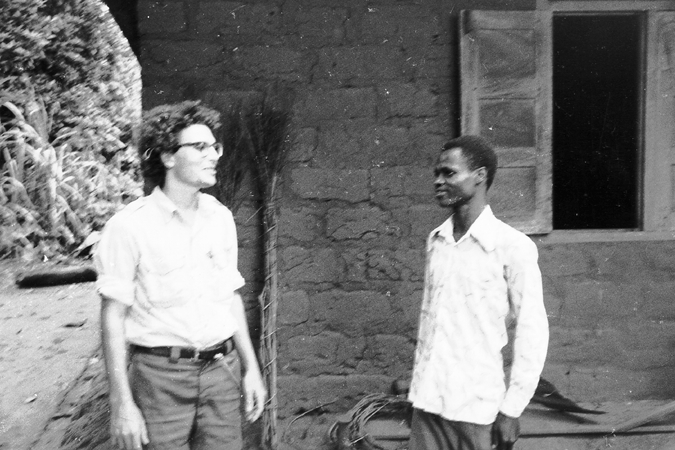
The complete list of 81 examples transcribed in the Appendix (pp. 110‑12) can be heard in the same order here. Here's a foto of the speaker, Julius Ògbú, and me.
Significant correction: Ex. (18a) as cited on p. 109 is observationally correct in some prominent Ìgbo varieties — e.g. it occurs as such in Ḿbàisén and adjacent areas — but not in Standard Ìgbo, moreover the form as given on p. 109 is misleading with respect to clause‑typing. In Standard Ìgbo, the verb root plus suffix in a subject question of this inflected form bears L, not downstepped H:
Ònyé hù̩‑ru̩ Ézè? 'Who saw Ézè?' = [LH LL HL].
But Standard Ìgbo does maintain the downstepped H in subject relative clauses like (18a) = [H!H !HH H!H]. Accordingly, one might well claim that T‑to‑C (or Infl‑to‑C) does occur in (18a), just as indicated in the paper, but there is no prosodic evidence for parallel treatment of (18b), contra the little upward arrow to the left of ‑rV in the tree structure in (18b). Incidentally, the identification of Ìgbo finite ‑rV as a morphological instantiation of the Infl or Tense node of the clausal Middle Field, assumed in 1992 the paper, must be abandoned for independent reasons of temporal and aspectual quantification. Specifically, the longstanding controversy in the Ìgbo literature regarding the temporal content of ‑rV inflection dissolves, once ‑rV is recognized to have the distribution of an argument‑type clitic.Otherwise, the general point of the paper remains unaffected: so‑called "upstep" is epiphenomenal, and is not an upside‑down counterpart of "downstep" as pretended in taxonomic ("tagmemic") work by E. Pike and maintained by many Africanists with the help of enriched autosegmental‑metrical notation. Rather, "upstep" is no more than the phonetic realization of antidownstep (downstep reset), a phenomenon itself constrained by syntactic phrasing. Several elementary and general observations support this conclusion, quite apart from the particular analysis of Ágbò̩ presented in my paper. First, there is no antidownstep without a preceding downstep in the relevant prosodic domain. Secondly — and this point was admitted anecdotally during the roundtable discussion at the 1992 UPenn workshop by the two invited SIL Mayanists — Mayan languages do not show upstep cumulation, contra E. Pike's published descriptions that started the whole upstep goosechase. Naturally, upstep retains support as a strictly phonetic category, my only purpose here being to show that it plays no role in the statement of linguistically significant generalizations. In sum, phonological use of the term upstep is, on current knowledge, nothing more than a hypostasis or in other words a mystification. SIL/Wycliffe may possess excellent soteriological reasons to look "upward" as much as "downward", but natural languages including Ìgbo and apparently also the Mayan family are quite innocent of this skyward temptation, and should not be blamed for it.
[Update 6 December 2012] Another tell that syntax is not 'different' (in the sense of Bromberger & Halle 1989) is that not only prosodic footing, but also syntactic agreement, has now been enthusiastically offered as grist for an upward‑looking parameter of structural variation across natural languages (Baker 2008). Automatic sacrifice of restrictiveness is always expedient in the short term, but always too a bad idea for constructing testable theory‑space (Martin & Osherson 1998) and at least as far as Niger‑Congo languages are concerned, always a recipe for exoticism.
Baker, M. [2008]. The Syntax of Agreement & Concord. Cambridge University Press.
Bromberger, S. & M. Halle. [1989]. Why phonology is different. Linguistic Inquiry 20, 51‑70.
Martin, E. & D. Osherson. [1998]. Elements of Scientific Inquiry. MIT Press, Cambridge Mass.
Journal of African Languages & Linguistics 14, 108‑16. [ISSN 0167‑6164]
Published typos hand‑corrected in this offprint.
[Spreading and downstep; prosodic government in tone languages]**
The Phonology of Tone; the Representation of Tonal Register, edited by H. v.d. Hulst & K. Snider, 133‑84. De Gruyter, Berlin. [ISBN 3110136058]**Note: archival offprint available on request; all the content is folded into my dissertation as pp. 61‑93.
[Verb focus in the typology of Kwa/Kru and Haitian]**
Focus & Grammatical Relations in Creole Languages, edited by F. Byrne & D. Winford, 3‑51. Benjamins, Amsterdam. [ISBN 1556191669]**Note: archival offprint available on request; all the content is folded into my dissertation as pp. 188‑220.Significant empirical wrinkle: In Yorùbá, clefted nominalized focus of the full VP, as in exx. (46b, 48, 57b) on pp. 20‑22 of the published version [= exx. (80b, 82, 91b) on pp. 203f. of the dissertation] exists independently in the literature (Awóyalé 1985, 78; Ajíbóyè & al. 2004, 33) but is rejected by other speakers. The conditions of this disagreement remain obscure to me!
Ajíbóyè, O̩. & al. [2004]. On the syntax of nominalization in È̩dó and Yorùbá. Kinyĩra Njĩra! Step Firmly on the Pathway! Trends in African Linguistics 5 = Selected Papers from ACAL 31 at Boston University, edited by C. Githiora & al., 23‑42. Africa World Press, Trenton N.J.
Awóyalé, 'Y. [1985]. Focus as an unbounded movement rule in Yorùbá. Journal of the Linguistic Association of Nigeria 3, 75‑83.
Joint paper with R.‑M. Déchaine.
Natural Language & Linguistic Theory 12, 203‑57. [ISSN 0167‑806X]
Joint paper with K. Hale & Ụ. Íhìọ́nụ́, based on 24.942, the Spring, 1994 field methods class at MIT.
Theoretical Approaches to African Linguistics [= papers from ACAL 25, Rutgers University], edited by A. Akinlabí, 83‑107. Africa World Press, Trenton, N.J. [ISSN 1080‑5478]
Langues et Grammaire, Actes du Premier Colloque, édités par L. Nash et G. Tsoulas, 237‑52.
Département des Sciences du Langage, Université de Paris‑8, Vincennes à Saint‑Denis.
Niger‑Congo Syntax & Semantics 6, edited by V. Manfredi & K. Reynolds, 91‑112. Boston University African Studies Center.Significant empirical wrinkle: contra the standard description exemplified in ex. (5b) on p. 92, Adéṣọlá (2005, 190f.) observes two examples of ōrātiō oblīqua in which the possible reference of an embedded 3sg. nominative clitic can include the main clause subject. Specifically, ó may optionally share the referent of Olú in the following examples:Granting that these data entail a breakdown of referential complementarity between the independent (òun) and clitic (ó) 3sg pronominal expressions, such breakdown is not unusual for morphological competition among pronominals across the binding literature as a whole (as reviewed here). The more relevant question is whether Adéṣọlá's observations disprove domain extension and by implication any syntactic account of antilogophoricity including mine. I hold that these new data require a more, not less, syntactico-centric architecture:(i) Olú ti gbà [kí ó má .jẹ ìrẹṣì mọ́].
O. AUX receive COMP 3SG AUX eat rice any.more
'Olú agreed that s/he (= Olú or someone else) should not eat rice again thereafter'
(ii) Olú ti kéde [pé ó ń bọ̀ l'ọ́la].
O. AUX cry.proclamation COMP 3SG AUX come tomorrow
'Olú announced that s/he (= Olú or someone else) is coming tomorrow'
No [logo]
[21 January 2026, 10 pp. A4, under review]
Niger‑Congo Syntax & Semantics 6, edited by V. Manfredi & K. Reynolds, 171‑82. Boston University African Studies Center.
International Journal of African Historical Studies 29, 557‑82. [ISSN 0361‑7882]
"Corrected republication" of subeditor's typographic botch in same journal vol. 29 pp. 95‑121.Update: Holloway & Vass align the stereotype of the "Bantu" as a "homogeneous group" sharing a "common origin" (1993, xiv) with the latter half of a famous political dyad, "the house Negro and the field Negro back during slavery" (Malcolm X 1963, 10). They state as follows:"In North America, Wolofs were primarily employed as house servants. …But as field workers the Bantus were kept away from the developing mainstream of white American culture." (1993, xx, xxv)Their view however contrasts with a Caribbean"discourse that has become widespread… wherein the 'Bantus' or 'Kongos' of central Africa stand for mixture, while the coastal Yorùbá and Dahomeyans (often referred to as Guinea or Nago) stand for purity and authentic Africanness" (Johnson 2007, 213).Taking these indirect reports at face value, the question is then why, in the respective zones of plantation settler-economy, the "Bantu" demographic profile acquired opposite polarities on the scale of perceived cultural assimilation.UPDATE 25 July 2018: For more concerted critique of "fundamentalist Afrocentrics" seeJohnson, P. [2007]. Diaspora Conversions; Black Carib religion & the recovery of Africa. University of California Press, Berkeley.
Malcolm X. [1963/1965]. Message to the grass roots. Malcolm X Speaks; selected speeches & statements, edited by M. Breitman, 3‑17. Pathfinder Press, New York.
Assunção, M. [2005]. Capoeira, the History of an Afro-Brazilian Martial Art. Routledge, London.
Object Positions in Benue‑Kwa; papers from a workshop at Leiden University, June 1994, edited by R.‑M. Déchaine & V. Manfredi, 87‑122. Holland Institute of Generative Linguistics/Holland Academic Graphics, The Hague. [ISBN 9055690317], publisher closed.Significant correction: On p. 104, the gloss given for Yorùbá the left‑hand example in (53a) i.e. without the pluralizer àwọn should not include the definite plural 'the dogs'. The excluded reading is in fact available in a similar example of Mandarin, as reported on p. 29 of R. Yang [2001] Common nouns, classifiers & quantification in Chinese (Dissertation, Rutgers University, New Jersey), but the two examples are nonparallel: the Mandarin crucially lacks a sortal classifier which arguably corresponds to little n, and in the Yorùbá example the notional noun has a closed‑class prefix which again arguably corresponds to little n. The interpretive difference disproves any structural equation between the bare noun root of Chinese and the minimal free form of Yorùbá; the latter is structurally a bare singular as discussed below, and allows a plural reading if either indefinite or inanimate, as preciently noticed by Welmers [1973] African Language Structures (University of California Press, Berlekey), p. 220.
Cahiers d'études africaines 145, 157‑211. [ISSN 0008‑0055]The first public outing of this material received same-day support from an unexpected source (3pp. letter).This article fills in a placeholder blurb in my dissertation (§4.5, pp. 304f.). The pertinent É̩hu̩gbò text, reproduced on pp. 195‑201, was copied verbatim from the dissertation (pp. 343‑48) where it was transcribed with more attention to content than to dialect‑particular inflectional morphology or to consistency of orthographic word division — both issues in need of reconsideration. The respective audio (runtime 7:31), posted here, was recorded on 19 June 1977 from Éléje Aghá, a renowned díbì̩a 'oraclist' of the Ńdi̩ Uchè Ú̩rò̩ moiety of Kpóghirikpó village, while seated in the veranda of Ńnàlí̩ Ì̩du̩ma whose supporting voice can be heard in the background.Significant correction: On pp. 177f., I proposed in passing that the Ìgbo nouns for 'reincarnating spirit double' and 'day(light)', both of which are pronounced chí, share a common root which is still productive in the language as a so‑called 'verb extension' meaning either 'repeat' or 'return'. This idea is however disproved by one simple fact which I should have checked at the time, namely that the predicative root in question has an aspirated onset consonant in all Ìgbo dialects which include this phonological feature, whereas the two nouns do not (cf. pp. 110 and 119 of Rev. Ígwè's 1999 Ìgbo‑English Dictionary). Hence it is impossible for that predicative root to be historically connected to either of the two nouns, and so an alternative explanation is required if the nouns are etymologically linked to each other at all. (Of course the null hypothesis is also possible, that 'day(light)' and 'reincarnating spirit double' are accidental homophones in Ìgbo, but as astute a cultural commentator as Òdógwu Chínù̩á Àchebé ventures otherwise, in his famous 1975 essay "Chí in Ìgbo cosmology".) Moreover there can be no doubt that the 'day(light)' meaning of chí is ancient, indeed it is reconstructed by Mukarovsky (1976, 146, 152) all the way back to a stage close to the ancestor of the entire Niger‑Congo language family, therefore it would be highly unlikely for an etymology of this word to be still recoverable Ìgbo‑internally. Accordingly, a new proposal is made in the final section of this manuscript, taking into account a cosmological comment in Melzian's È̩dó dictionary for the analogous noun è̩hi: "It is believed to be 'with a man all the day' " (1937, 51). Based on this remark (which is probably attributable to Melzian's primary consultant, Mr. H.G. Amadasu), and on supporting evidence cited there, I suggest that the Ìgbo noun for 'reincarnating spirit double' is historically identical to the noun for 'day(light)' thanks to a trivial metonymy of a thing to its canonical context, motivated by an assumption which was originally made by Northcote Thomas (1914, 19) and which can scarcely be doubted by anyone who has compared the two neighboring civilizations, to the effect that the cosmological pragmatics of È̩dó è̩hi and Ìgbo chí are remarkably parallel. The analogy is further demonstrated at Ágbò̩ ("Agbor"), the intermediate border kingdom with strongly bicultural Ìgbo and È̩dó leanings, where è̩hi appears in countless personal names in the same 'slot' in which chí is found in the eastern Ìgbo counterparts, to all appearances synonymously, e.g. È̩hi edú = Chí nà‑edú 'the reincarnating spirit‑double leads'.UPDATE 23 April 2014: The standard assumption that twins infanticide had economic/evodevo utility, reducing investment in offspring of lower life expectancy, still begs a cultural explanation for a widespread but far from universal precolonial practice. Ethnographers may paraphrase local opinion about "uncanny" (Thomas 1913, 12) or "unnatural" births: "For a woman to bear more than one child at a time was regarded as degrading humanity to the level of beasts" (Úchèńdù̩ 1965, 58; cf. Basden 1921, 57f, Thompson 1971, 10, 79), but vague sentiments of aversion, potentially reflecting "secondary reasoning and reinterpretations" (Boas 1910, 67), fail to address intricately stratified legal‑cosmological codes like the 100‑plus ǹsó̩ àla 'communal taboos' (lit. 'things prohibited by the earth'), including birth omens, operant at Ǹri well into the 20th century (Ó̩nwu̩ejìó̩gwù̩ 1981, 52ff.). Schapera dismissed the "obvious explanation" of generic abnormality as circular, seeking instead "the meaning of the various customs related to twins" in indigenous ideas such as the "occurrence of two individuals with identical personalities" (1927, 134ff.), but despite this advice the most influential 'theory' of the matter merely rephrased the commonsensical account in elevated terms like "paradox", "anomaly", "dilemma" and "structural contradiction" (Turner 1969). In two adjacent northwest Cameroun communities speaking Benue‑Kwa (socalled wide Bantu) languages, terms rendered in English as "single twin" are ritually applied to biologically singleton births by oraclists seeking to interpret "individual and social problems in [terms of] the behavior of discontented ancestors" (Diduk 1993, 552, cf. Argenti 2011, 283, 286). Extending the idea to Ìgbo, hypothetically the chí could have been regarded as the individual's twin, and conversely one member of a biological twin birth — but which one?—was therefore the other one's chí. If so, then a twin birth could not lead to further reincarnation. This conjecture awaits relevant evidence pro or con.Argenti, N. [2011]. Things of the ground [= earth]; children's medicine, motherhood and memory in the Cameroun grassfields. Africa 81, 269‑94.
Basden, G. [1921]. Among the I[g]bos of Nigeria; an account of the curious & interesting habits, customs & beliefs of a little known African people by one who has for many years lived amongst them on close & intimate terms. Seeley, London.
Boas, F. [1910]. Introduction. Handbook of American Indian Languages 1, 1‑83. Government Printing Office, Washington, D.C.
Diduk, N. [1993]. Twins, ancestors and socioeconomic change in Kejom society. Man 28, 55‑71.
———. [2001]. Twinship and juvenile power; the ordinariness of the extraordinary. Ethnology 40, 29‑44.
Ó̩nwu̩ejìó̩gwù̩ ("Onwuejeogwu"), M. [1974/1981]. An Ìgbo Civilization; Ǹri Kingdom & hegemony. M.Phil Thesis, University College, London/Ethnographica, London for Ethiope, Benin-City.
Schapera, I. [1927]. Customs relating to twins in South Africa. Journal of the Royal African Society 26/102, 117‑37.
Thomas, N. [1913]. Anthropological Report on the Ì[g]bo‑speaking Peoples of Nigeria, 1; law & custom of the Ì[g]bo of the Ó̩ka neighborhood, S. Nigeria. Harrison, London.
Thompson, R. [1971]. Sons of thunder; twin images among the Ò̩yó̩ and other Yorùbá groups. African Arts 4.3, 8‑13, 77‑80.
Turner, V. [1969]. Paradoxes of twinship in Ndembu ritual. The Ritual Process; structure & antistructure, 44‑93. Aldine, Chicago.
Úchèńdù̩, V. [1965]. The Ìgbo of Southeast Nigeria. Holt, New York.
Joint paper with R.‑M. Déchaine.
Recherches Linguistiques de Vincennes 27, 71‑94. [ISSN 0986‑6124]Significant correction: A referential plural gloss is systematically and erroneously attributed to cased, bare animate nPs in Ìgbo. The interpretation 'rats' should be deleted wherever it appears in examples (18b), (19b,c), (20a), (22a,c), (25a), (28), (29), (36a), (40a). The mistake is not directly relevant to the argument of the paper.
Encyclopedia article, prepared jointly with E. Ézè.
Facts about the World's Major Languages; an encyclopedia of the world's major languages, past & present, edited by J. Garry & C. Rubino, 322‑30. H.W. Wilson, Bronx, New York [ISBN 0824209702].BIBLIOGRAPHIC CORRECTION: In view of perpetually inflated, conjectured and undocumented casualty stats of the Biafran-Nigerian war, I should record that we mistakenly let the house editors delete our manuscript reference to, and quotation marks surrounding, the phrase "between half a million and a million" originally cited from p. 412 of J. de St. Jorre, The Nigerian Civil War (Hodder & Stoughton, London 1972, ISBN 034012640X). Here is a fuller quotation from that page:"The pursuit of Nigerian unity killed between half a million and a million Nigerians. [FN1: There are no official figures and, since accurate records were not kept by either side, a reliable estimate of casualties may never emerge. My figure is a consensus of informed opinion and I personally feel that something around 600,000 — for total deaths — may be nearest the mark.] (The Spanish and American civil wars exacted a similar human price.)"Grabbing a bag of third-hand authorities, Chínù̩á Àchebé canonised "over two million" as the Biafran score in the genocide olympics (There Was a Country; a personal history of Biafra, Allen Lane, London 2012, ISBN 9781594204821, pp. 228, 312 fn. 1), but such extrapolations ignore inherited inaccuracies (S. Àlùkò, "How many Nigerians? An analysis of Nigeria's census problems 1901-63", Journal of Modern African Studies 3 [1965], 371-92; R. Údò, "Population and politics in Nigeria", The Population of Tropical Africa, edited by J. Caldwell & C. Òkóńjo̩, Heinemann, London 1966/1968, 97-105) pumped up by oil-rent "prebendalism" (per Richard Joseph ISBN 9780521341363) and enhanced by pronatal ideology that flips the biblico-darwinian imperative "be fruitful and multiply" into a less reliable short-run expectation of multiply and be fruitful (e.g. K. Oyèédìran, "Fertility desires of Yorùbá couples of Southwestern Nigeria", Journal of Biosocial Sciences 38 [2005], 605-24).
On Biafran mortality, we should have simply quoted Thierry Hentsch who coordinated Red Cross relief throughout the war:Combien de réfugiés ont-ils finalement péri? Personne ne les a dénombrés, mais chacun le sait: trop. Il serait donc impossible et indécent de voulouir faire le compte des vies épargnées. Il suffit de savoir que chaque dose de médicament, chaque gramme de protéine avait plus de valeur qu tout l'argent dépensé au cours de ces deux ans et demi de guerre.
[How many refugees eventually died? Nobody counted them, but everybody knows the number was too many, and that to pretend to count the lives saved would be impossible and obscene. All we need to know is that every dose of medicine, every gram of protein was more precious than all the money spent waging this war for two and a half years.]
(Boldface added here.)
Source: Face au Blocus; la Croix-Rouge internationale dans le Nigéria en guerre 1967-1970 (Librairie Droz/Institut universitaire de hautes études internationales, Genève 1973), p. 253.Tone correction: LHL tones printed on the language name "Igala" on pp. 24 (fn. 15) and 31 should be HHL, as already noted for my dissertation (above).
Typologie des langues d'Afrique et universaux de la grammaire, vol. 2: Benue‑Kwa, Soninke, Wolof [publisher page], edited by P. Sauzet & A. Zribi‑Hertz, 127‑62. Presses Universitaires de Vincennes/Éditions de l'Harmattan, Paris. [ISBN 2747554872; manually corrected proofs]
In the Linguistic Paradise; a festschrift for E. Nwánò̩lúe Eménanjo̩, edited by O̩. Ńdi̩méle, 581‑91. National Institute for Nigerian Languages, Àbá. [ISBN 978289107X; manually corrected proofs]
Contours; a journal of the African diaspora 2.2, 239‑87. [ISSN 1543‑902X], journal deceased.Tone typo: The second word in fn. 27 (p. 270) should be Ékpè [HL] and not Èkpe [LL]; the LL item refers to a dance genre (i.e. a subtype of the large category of performances called in Ìgbo égwu [HH]) rather than to the title society under discussion which happens to deploy its own proprietary masked dance representations. The latter institution is denoted by the HL item wherever it is found, including the southern and eastern Ìgbo‑speaking area (cf. Ígwè, Ìgbo‑English Dictionary, University Press Ltd., Ìbàdàn 1985‑1999, p. 155) and specifically in Árụ̀ (= colonial "Arochukwu", cf. video interview with Ézè Árụ̀ by I. Miller, 2008) where the title society has big political clout. Two observations show that the respective forms with HL and LL represent one single word which traveled distinct historical paths, as opposed to being random near‑homophones. First, festival songs of "Èkpe" [LL] in Ọ́màáhyá (= colonial "Ụmụahi̩a") include numerous emblematic references to ágụ́ [H!H] 'leopard' (cf. E. Íkeokwú long essay, Department of Linguistics & Nigerian Languages, University of Nigeria, Ǹsụ́ka 1984, pp. 18f.). Second, the Ẹ̀dó word for 'leopard' is è̩kpe̩n (cf. Melzian, Concise Dictionary of the Bìní Language of Southern Nigeria, London, 1937, p. 53), with the same LL as in the Ìgbo word for the dance genre. (The nasalization of the root in the Ẹ̀dó reflex is probably related to the syllabic nasal which constitutes the noun prefix, sometimes singular and sometimes plural, of 'leopard/panthère' in many of the languages sampled in the Benue‑Congo Comparative Wordlist, Ìbàdàn 1968, pp. 222‑25.) In sum, the existence of the form ékpè [HL] in Ìgbo‑speaking communities reflects the borrowing from Èfịk of the historic word for 'leopard' along with its Èfịk pitch pattern of [HL], used as the proper name for the leopard‑themed title society which flourished in the catchment area of the Èfịk trade empire known to European merchants and colonists as "Old Calabar" (cf. Talbot, Peoples of Southern Nigeria, 1926, pp. 183f.). This borrowing endowed many southern and eastern Ìgbo‑speaking communities with a secondary lexical item separate from the primary/inherited Ìgbo form of the word with LL, which had meanwhile lost in Ìgbo the literal denotation of 'leopard' (having been supplanted by the hypokoristic ágú̩, literally 'the ravenous one', cf. águ̩ú̩ or águ̩ó̩ [HH!H] 'hunger') and become semantically opaque in the specialized context of phrases like í̩gbá èkpe [H!H LL] referring to heroically vigorous dance‑play — so‑called from its emulation of what the 1986 Nobel laureate in literature might like to call the leopard's "tigritude" or more prosaically, "a type of dance requiring much energetic action and so restricted to able‑bodied young men" (Ígwè p. 155).Missing from references:
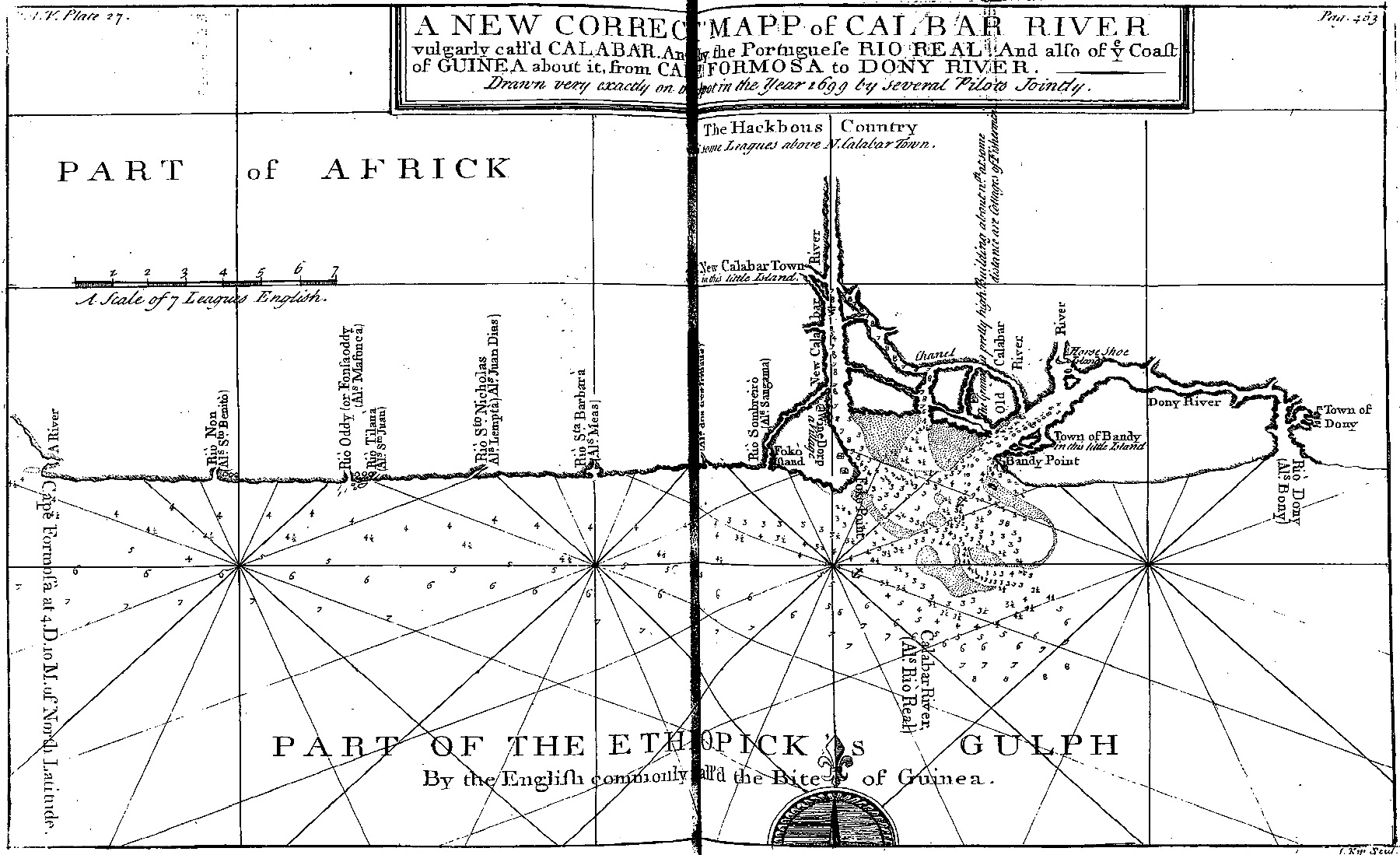
Significant empirical wrinkle: The cartographic errorism — what would today be called unavoidable and regrettable targeting error — responsible for sticking the name "Calabar" on the Efịk capital is much less complex in legendary inspiration, and slightly less farfetched in geographic distance, than modern historians have supposed. As quoted in the paper (p. 254), Jones wondered whether "the European attribution of the name Old Calabar to the Efịk people could be a reflection of the Korome myth of origin [… about] the place which the Opukoroye line of Kalaḅarị kings claimed as their original home" (1965, 159). More plausibly and prosaically, Ejituwu suggests that the intended referent of the "old" term in this myth was not the Efịk‑speaking village group on the "Rio da Cruz", but instead a Kalaḅarị‑speaking settlement (subsequently abandoned) on a branch of the "Rio Real" estuary labeled "Old Calabar River" by Barbot's 1699 "New Correct Mapp of Calbar River" (reprinted by Barbot 1732, 462 and Ejituwu 1998, 137). Further ambiguity (as if any were required) is supplied by the fact that "when New Calabar itself segmented from 1879 to 1885 […] [t]he Kalaḅarị in Bakana, Abonema and Buguma continued to regard New Calabar as Elem Kalaḅarị, which means 'Old Calabar', and the latter continued to appear in official documents till 1931" (Ejituwu 1998, 142). None of this confusion is surprising, given that adnominal modifiers like old and new are indexical "shifters" whereas map terms ideally aren't. But unlike Jones' frankly speculative account of the Efịk mistaken identity for "Calabar", Ejituwu's explanation of the mishap has independent documentary support and is moreover simpler: no need to assume that Dutch mappers of 9ja's eastern coast had even indirect access to Kalaḅarị dynastic tales, if what happened is that they ploddingly reproduced some coastal traders' casual misplacement of the older of the "Old" Calabars — i.e. the one so designated by locals in the 17th century — by a few hundred miles, to a different slaving depot a few estuaries further along to the east, albeit in a very different linguistic territory.Crabb, D. [1965]. Ekoid Languages of Ogoja, Eastern Nigeria. Cambridge University Press.
Jones, G. [1957]. Report of the position, status & influence of chiefs & natural rulers in the Eastern Region of Nigeria. Government Printer, Énugwú.
Current best guess for the pronunciation of the Árù̩ term "otusi" (quoted on p. 257 of this paper from Díké & Ékèjiu̩bá 1990, 48) is ó̩tù̩sí̩ (per I. Miller p.c.). An open question is the historical relationship hypothesised by Kánú (2000, 57f.) with the Ǹri term "otonsi" (illustrated by Ó̩nwu̩ejìó̩gwù̩ 1980, 84 plate 26) whose pronunciation remains for now unknown.Eltis & al. scratch their heads while musing why, despite a clear finding of greater Ìgbo-speaking than Yorùbá-speaking numbers in the historical demography of the Middle Passage, "no one can claim that the Ìgbo influence on the 19th century Black Atlantic was as great as that of the Yorùbá… [T]here can be no doubt that Ìgbo has had a lower profile in the evolution of all diasporic contexts… whether we examine language survival, religion [sic], community organzation or indeed resistance" (2024, 725f.). Their conundrum is however self-imposed by embracing the nominalist fallacy that Ìgbo-speaking individuals are ipsō factō Ìgbo-monolingual, Ìgbo-monocultural and so on all the way down to their Ìgbo-speaking toes. Such facile literalism enjoys elective affinity to modern ethnolinguistic nationalism, the same presentist, ahistoric ideology that has prospered the neo-Yorùbá project much more than it ever helped the survivors of the Republic of Biafra to wave an identitarian flag — the quaintly exotic Hebrewphilia of Rev. Basden, Lt. Col. Òjúkwu and Rebbe Ńnàḿdì̩ Kánú being the populist default nowadays. In sum, their puzzle is a conceptual tautology. Empirically, the romance of monoculture is massively contradicted in West African ethnography and disproved for the case at hand by Ékpè, the hegemonic supralocal institution that spanned the Cross-River basin under mercantilism and which was autonomously replanted in western Cuba largely by Ìgbo speakers, in the teeth of colonial policing, as la sociedad secreta Abakuá.Kánú, O. [2000]. The Pre-British Árù̩ of Árù̩chúkwu; notes & reflections on an African civilization. USAfrica Books, Houston Texas.
Eltis, D. & al. [2024]. The origins and destinations of captives from the Bight of Biafra 1807-1843; new evidence from the identification of African names and languages. Slavery & Abolition 45, 705-32.
Focus Strategies in African Languages; the interaction of focus & grammar in Niger‑Congo & Afroasiatic [publisher page], edited by E. Aboh & al., 15‑54. DeGruyter, Berlin. [ISBN 9783110195934, ISSN 1861‑4302]. Final manuscript [17 pp. A4]. Offprints available by request.UPDATE 2 NOVEMBER 2010: Encouraging agreement with this analysis in many empirical as well as theoretical respects (though with significantly different formal implementation) can now be consulted in the following publication:Zubizarreta, M.‑L. [2010]. The syntax and prosody of focus; the Bantu‑Italian connection. Iberia; An International Journal of Theoretical Linguistics 2, 131‑68.
Historical Syntax & Linguistic Theory [publisher page] (= DIGS 9, the Ninth Diachronic Generative Syntax Conference, Trieste 2006), edited by P. Crisma & G. Longobardi, 329‑43. Oxford University Press. [ISBN 0199560544]. Prefinal proofs [15 pp.] plus bibliographic references for this chapter in manuscript form [4 pp. A4]. (Omnibus references for the volume appear on pp. 375‑412 of the actual publication.)
ABSTRACT: Niger‑Congo's Kwa and Benue‑Congo zones, jointly covering most of tropical Africa, run between isolating and agglutinative types. Historical phonology finds few shared innovations above the local cluster, but assuming the phase theory of generative syntax, a sharp division emerges based on the timing (early/VP vs. late/TP) of PF‑spellout.
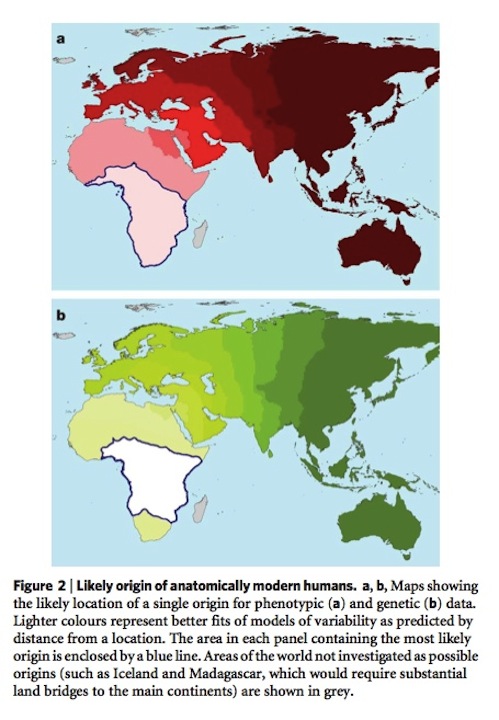
TYPO: The verses of Ogbè Ògúndá describing erosion of orí inú, referenced on p. 343, fn. 17 of this paper, are found on pp. 193ff. of Abím̄bó̩lá (1975).UPDATE 18 July 2007: A letter in the current issue of Nature reports that paleontological and genetic data converge in reconstructing human origins to an area which — as I can't help noticing — happens to coincide closely with the current Benue‑Kwa speaking area. See this screenshot of Fig. 2. Likely origin of anatomically modern humans from p. 347 of A. Manica & al., "The effect of ancient population bottlenecks on human phenotypic variation" (Nature 448, 346‑48, 19 July 2007). Of course the observation is anachronistic, because the physiological reference point is >50K years old while BK's collective identity is presumably much younger, but the areal coincidence is still striking. A more neutral paraphrase: present BK‑speaking populations include the greatest phenotypic as well as genetic diversity of any large‑scale human aggregate. This result cannot lessen the general interest of comparative BK studies, but I predict that someone soon will conveniently forget the "K" (Kwa) part of "BK" (Benue‑Kwa) and try to interpret these maps in a Bantuist vein!Abím̄bó̩lá, 'W. [1975]. Sixteen Great Poems of Ifá. Gaskiya, Zaria, for Unesco.
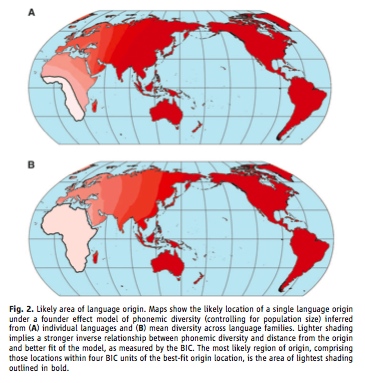
UPDATE 15 April 2011: It's disappointing that anyone would be counting "phonemes" nearly a century after Jakobson, Karcevsky & Trubetskoy discovered binary distinctive features and implicational universals (la regularité des rapports de corrélations), cf. "Quelles sont les méthodes les mieux appropriées à un exposé complet et pratique de la grammaire d'une langue quelconque?" (Actes du premier congrès international de linguistes à La Haye, du 10‑15 Avril 1928, 32‑36; reprinted in Roman Jakobson Selected Writings 1; Phonological Studies, 3‑6. Mouton, The Hague) and 25 years after Kaye, Lowenstamm & Vergnaud refined this idea as a sub‑syntax of unary/privative phonological elements, cf. "The internal structure of phonological elements; a theory of charm and government" (Phonology Yearbook 2 [1985], 305‑28). Nevertheless it's still probably significant that the demography of taxonomic (pre‑Jakobsonian) lexical contrast units — roughly, phonetic phenotypes — converges on the same originating population as does the demography of human anatomical genotypes: once again, the presently‑existing historically‑defined linguistic unit most closely corresponding to the set of languages in question is Benue‑Kwa. Twice lucky? See the top half of " Fig. 2. Likely area of language origin" from p. 347 of Q. Atkinson, "Phonemic diversity supports a serial founder effect model of language expansion from Africa" (Science 332, 346‑49, 15 April 2011) or this screenshot.
UPDATE 15 September 2012: Some of the same issues are covered in Hyman (2004), a learned survey enlarging Westermann's (1927) broad observation of east‑to‑west decline in morphosyntactic complexity and in the maximum size of predicate roots. In the absence of theory, of course, there can be no expectation of quantal restructuring. Instead, Hyman suggests (i) that the innovations under investigation "modified the proto system… in an areal fashion" (p. 71) and (ii) that the process was not unidirectional, since Ìgbo is cited as a language in which "doubtless… extensions have arisen via renewals" (p. 86). But how far can a theoretically untrammelled picture of reversible Wellen be maintained while still admitting a large‑scale structural shift towards isolating syntax and monosyllabic roots? Can such a dramatic diachronic asymmetry, expressed across vast stretches of time and space, be more than a statistical fluke? Part of the problem may be that Hyman bravely assigns himself the whole of "Niger‑Congo" (the world's oldest and most complex language family) as the canvas for his illustrations, whereas Westermann's original observations were restricted to the more tractable — but still impressively big — zone which came to be known as "Benue‑Kwa" (e.g. Elugbe & Williamson 1977). It's also surprising that someone who went on to write Hyman (2011) would not follow up his own observation that "almost all Bantu languages show stembound phonological prosodies" (p. 85) by mentioning the markedly richer tonemic inventories at the "Kwa" end of the spectrum. (Either that's another accident, or else tone is really "different" after all. Not both.) Aligning his three parameters of change, Hyman notes that "at least relics of the original morphology survive beyond the syntactic and phonological restructurings" (p. 86), entailing that "syntax" changed autonomously to some extent, and hinting at no mechanism connecting syntax to the shape of roots. Coincidence upon coincidence.Elugbe, B. & K. Williamson. [1977]. Reconstructing nasals in Proto-Benue Kwa. Linguistic Studies Offered to Joseph Greenberg 2, edited by A. Juillard, 339‑63. Anma Libri, Saratoga.
Hyman, L. [2004]. How to become a 'Kwa' verb. Journal of West African Languages 30, 69‑88. [free prepress version]
———. [2011]. Tone; is it different? Handbook of Phonological Theory, 2nd edition, edited by J. Goldsmith & al., 197‑239. Blackwell, Oxford. [free prepress version]
Westermann, D. [1927]. Die westlichen Sudansprachen und ihre Beziehungen zum Bantu. [=MSOS 29 Beiheft]. DeGruyter, Berlin.
UPDATE 16 May 2013: BK2's birth being the hypothetical result of deletion (specifically, the erosion of finite inflection), or so I say, risks the irrelevance of a linear branching model of substantial inheritance — as opposed to disinheritance. It makes you wonder what share of i‑language speciations are of this general type, and whether identification of more such events could reduce apparent radiation/multibranching in archaic Stammbäume — a matter which continues to disquiet Indoeuropeanists, most of whom understandably were trained to study e‑language (e.g. Garrett 1999). Genetic reduction is a live topic in cellular phylogeny (Bapteste & Gribaldo 2003) though not as hot as incongruence/lateral transfer (Leigh & al. 2011).Bapteste, E. & S. Gribaldo. [2003]. The genome reduction hypothesis and the phylogeny of eukaryotes. Trends in Genetics [ISSN 0168‑9525] 19, 696‑700.
Garrett, A. [1999]. A new model of Indo‑European subgrouping and dispersal. BLS [ISSN 0363‑2946] 25, 146‑56.
Leigh, J. & al. [2011]. Evaluating phylogenetic congruence in the post-genomic era. GBE [ISSN 1759‑6653] 3, 571‑87.
Lingua 120, 1327‑32. [ISSN 0024‑3841].UPDATE 18 February 2015: In addition to the references given in the published review, the following is relevant and should have been included:Zwart, J-W. [2006]. Structural case and dependency marking; a neo-Jakobsonian view. Chicago Linguistic Society [ISSN 0577‑7240] 42.2, 77‑92. [Author's handout, open access.]
Ìgbo transitivity in a derivational frameworkÌgbo Language Studies 5, edited by C. Úchèchúkwu, 55‑71. (Annyco Publishers, Ú̩mú̩ǹze, ISBN 9789785143019.) [= Proceedings of Ìgbo Language Symposium 3, Zik University, Ó̩ka ("Awka"), Ànámbàra ("Anambra") State, 9ja ("Nigeria"), 28 November 2011.]
[6 pp. A4, author's proof with differing pagination, last modified 18 January 2012]Note: "Anambra" is the standard colonial rendition of Ò̩‑má‑mbàla 'The Alluviator' — a traditional apostrophe to the eponymous river that nurtured yam cultivation millennia ago with its annual silted floodwaters. Ànámbàra is suggested as a practical compromise between Ìgbo accuracy and English literacy, in the event that Ìgbo proper nouns would be decolonised, following S.P.I.L.C. recommendations decades ago and in line with the pioneering work of Ánò̩ká (1979).Ánò̩ká, G. [1979]. A Pronouncing Dictionary of Ìgbo Place Names. Ímò Newspapers, Òweré ("Owerri").
Ó̩gbàlú̩, C. & 'N. Éménanjo̩. [1978]. Recommendations of the Standardisation Committee of the Society for Promoting Ìgbo Language & Culture (Òtu Íwèlíte Asù̩sú̩ nà Oménàlá Ìgbo). Varsity Printers, Ò̩ni̩cha ("Onitsha").
Radical Egalitarianism; local realities, global relations [publisher page], edited by F. Aulino & al., 119‑36 with consolidated volume endnotes and references (Fordham University Press, Bronx, New York, 2013, ISBN 0823241904). Revisiting §4.4 of my dissertation and applying Tambiah's idea of "galactic polity" to the Niger Delta. [cover page plus 17pp. prefinal proofs of main text plus 4pp. A4 of individual endnotes and references, last modified 18 February 2012.]ABSTRACT: If the Southeast Asian "galactic polity" is defined by centripetal‑centrifugal "pulsation between modalities" of power (Tambiah 1976), something similar is true of West Africa's 'Asiatic' social formations — indigenous tributary monopolies that flourished during the transatlantic slave trade before becoming "encapsulated" in British rule (Otite 1975). Structural ambivalence explains how Fortes & Evans‑Pritchard (1940) could lump "stateless" Ìgbo and nomadic Nuer together into the "acephalous" political type. This paper reviews three southern Nigerian examples of evanescent hierarchy. In April 1979, Íkenchúku the youthful ruler of Ágbọ̀ Kingdom died from nocturnal gunfire during a land case and an electoral campaign, as an elderly chief was rewriting Ágbọ̀ history to push back the pendulum from absolutist primogeniture towards collective lineage rights. In November 1995, the writer Ken Saro‑Wiwa was eliminated by "judicial murder" ostensibly because he had denounced a list of ten Ogoni chiefs — four of whom were subsequently lynched — as having sold out to Shell Oil Corporation and General Abacha. In November 2000, an Ìgbo anthropologist was roughly rebuked by an Ìgbo historian for refusing to parse the slogan Ìgbo énwé ezè 'Ìgbo has no paramount ruler' as synonymous to colonial cliches like "Biafran society is traditionally egalitarian" (Òjúkwu 1969 cf. Meek 1937). Instead of treating these perturbations as unrelated events, Tambiah's framework suggests they are causally linked in a long‑term social formation, within which the entrenchment of local political brokerage is complemented by the steady collapse of nationalism.BIBLIOGRAPHIC NOTE: The main descriptive source of this study is Chief Augustin È̩gwabó̩ Ìdúùwe̩'s History of Greater Ágbò̩[r]. That irreplaceable text remains unpublished today, three decades after the author entrusted the manuscript to me, so I belatedly and apologetically post it here in its unfinished form of circa 1982. An unattributed ten‑page paraphrase/extract of Ìdúùwe̩'s manuscript is included in J. Butcher & al. "A critical analysis of the royal chronicle of Ágbọ̀r" (Benue Valley Project Paper 13, Dept. of History, Dalhousie University 1975). According to the introductory comment by Professor J. Webster, the material was forwarded by an unnamed history graduate of Ìbàdàn University.Correction: as now debunked, the "Possible image of a salon in General Babangida's château" presented in an earlier draft of this paper as §5.6 actually shows a California mansion. Nevertheless Babangida's immense personal wealth has no legal explanation.UPDATE1: The issues reviewed in this paper receive a less political take in a 25‑minute TV documentary, "George Oṣòdì: Kings of Nigeria", eliciting my response: "Déin in Abachan drag?".UPDATE2: In northern 9ja, the British rāj ended Sokoto vassalage in 1902-03 (Smith 1960, 201), but Lugardian indirect rule breaks down in a context of democratic opposition, thus in June 2014 the APC state governor blocked the Abuja PDP from imposing a client, filial successor to the Kano emirate.UPDATE3: Further evidence has emerged that Shell guided General Abacha's terror campaign against the Ogoni protest movement.Smith, M. [1960]. Government in Zauzau; a study of government in the Hausa chiefdom of Zaria in Northern Nigeria from 1800 to 1950. Oxford University Press.
TYPOS: In the caption of Fig. 8.1 (p. 126), the final, acute tone mark of ò̩fó̩ 'Detarium microcarpum or senegalense' and the initial, acute tone mark of Ó̩nwu̩ejìó̩gwù̩ are both misprinted as grave accents.UPDATE4: Superiority clash tears Delta traditional rulers apart, Guardian [Lagos], 20 August 2021.As Ìdúùwe̩ predicted after the bad end of Òbí Íkenchúku in 1979 and covert accession of exiled infant Kíagbò̩[r]ekúzi—photos (in swaddling clothes) on p. 132 of the main paper and (in red ágbada) on p. 3 of "Déin in Abachan drag?"—the decline of the Ágbò̩[r] paramount in the ranks of "traditional" Lugardian state-sponsored, postcolonial figureheads triggers squabbling about "self-aggrandisement" in the political pecking order of today's Delta State.UPDATE5: A 26-minute audio reviews evidence of Shell's instigation of the 1994 "judicial murder" of Ken Saro-Wiwa and 8 other Ogoni activists, of CEO Brian Anderson's personal offer to barter Ken's life in exchange for PR whitewash of oil pollution and of the company's finance for terrorizing "wasting operations" by General Abacha's Niger Delta expeditionary force. While such malfeasance shocks the conscience when scrupulously exposed by journalists and other nongovernmental observers, public record affords less vivid insight into many other similar cases in the region from the British colonial Anschluss to the present. This broadcast also sheds light on MOSOP's real "crime" as defined by the Nigerian state-oil complex, namely to have unmasked the role of local "VIP" chiefs as willing instruments of "indirect rule" subjugating and exploiting an African peasantry.https://www.bbc.co.uk/programmes/w3ct41cx
https://www.bbc.co.uk/sounds/play/w3ct41cx
Slick: The Story of Oil, Shell and Nigeria
Episode 2 of 4: On trial
Ken Saro Wiwa and Ledum Mittee come face to face with the power of the Nigerian state
13 Apr 2022
In the 1990s, as oil spills devastate the environment, Shell becomes persona non grata in Ogoniland. Then, when Ken Saro-Wiwa, Ledum Mittee and other activists leading the charge against Shell are accused of incitement to murder, they come face to face with the power of Nigeria's military government. BBC West Africa correspondent Mayeni Jones investigates a miscarriage of justice which has become an infamous moment in Nigerian history.
Research note—Òminigbo̩n facing È̩dó past and future.Ùmé̩wàe̩n: Journal of Benin & E̩doid Studies (Oswego New York) 1, 136-41. [ISSN 2473‑3415]Supporting documentation for Before Wazobi̩a; Òminigbo̩n and polyglot culture in medieval 9ja.
Ìgbo semiscriptalism — ìgwe bu̩ íke n'itínye akàrá ú̩dàólú!Ìgbo Language Studies 2, 11-20.
Prepared for Ìgbo Language Symposium 5, Zik University, Ó̩ka ("Awka"), Ànámbàra ("Anambra"), 9ja (“Nigeria”), November 2014.
[10 pp. A4, last modified 27 July 2017]ABSTRACT: Before the British Empire's Anschluss captured 9ja (the "Niger area"), various Ìgbo-speaking communities and their neighbors deployed an ideographic (nonphonetic) initiation code of gestures and graphic designs which by nature had no need to represent "tone" (lexical contrasts of perceived laryngeal pitch or fundamental frequency). With alphabetic literacy came no less than four tonemarking techniques, all of which remain in use for different purposes, and this multiplicity of means uncannily fits the proverbial norm of ìgwe bu̩ íke, a proverbial watchword of strength in numbers in the southeast angle of 9ja's geopolitical hexagon. This abundant methodological diversity is not about to be simplified by a (nonexistent) central planning office, and there's no imminent prospect of linguists or speakers agreeing on a single style of encoding linguistically significant prosody that's unrecoverable from immediate context. This paper reviews the clashing strengths and weaknesses of each type of Ìgbo tonemarking for various legitimate purposes. An exit from the present muddle needs a more adequate theoretical approach to Ìgbo prosody than linguistic science can offer right now, and a greater practical commitment to public education and media access than is possible in the currently collapsing political economy of a vanquished province of a neoliberal neocolony.UPDATE 9 May 2023: The slogan "Obidient", self-applied to the social movement formed in the 2023 electoral campaign of the Nigerian Labour Party, qualifies as a nondiacritic, meta-linguistic tonemark. This bilingual coinage, denounced by Nigeria's Nobel Laureate™ as "one of the most repulsive, off-putting concoctions I ever encountered in any political arena" verging on "fascism", displays iambic homophony between its initial syllables "Òbí…" and the candidate's surname (literally 'patrilineal ancestral shrine') and demonstratively excluding "Óbì" [sic], as the LP candidate's patronym is usually garbled by foreign anglophones applying default trochaic stress (The Sound Pattern of English, p. 35). Which speaker of any language can miss the echo of Òbí and òbí-dient, how much less the wit who "christened Soy-ink" half a century ago (The Man Died; prison notes of 'Wo̩lé S̩óyín̄ká, p. 245)?
Cyclic accentuation in YorùbáData-rich Linguistics; papers in honor of 'Yíwo̩lá Awóyalé, edited by O. Adés̩o̩lá & al, 211-36. Cambridge Scholars Publishing, Newcastle-upon-Tyne, England.
[prefinal proof, 24pp. A5, last modified 15 January 2017]ABSTRACT: In Standard Yorùbá phonology, lexically spurious H tone marks each cyclic node, like English nuclear stress (Bresnan 1971, Cinque 1993, Wagner 2005, Zubizarreta & Vergnaud 2006). Squaring this fact with assumed tonal autonomy forces a choice between two ad hoc analyses: either (i) amnesty all spurious Hs as homophonous "tonal morphemes" (Welmers 1959) or else (ii) sprinkle them as pitch accents into an unrestrictive "autosegmental-metrical" mix (Ladd 1996). But the circularity is avoidable, because tones are generative impostors, first induced by structuralist discovery procedures (Jones 1928, Chao 1930, Pike 1948) then pasted wholesale into formalist notation (Williams 1971, Leben 1973, Goldsmith 1976). The critique of taxonomic phonemics (Halle 1959, Chomsky 1964) should favor the derivational theory "…that it will not be possible to classify languages into 'tone languages' and 'languages with pitch accent system' in any non-arbitrary way, but it will be possible to speak of a language as having a pitch accent system up to some point in the ordering of its rules and having a tonal system from that point in the rules on" (McCawley 1970, 529). Forty years later, Clements & al. finally concede the argument "against universal tone features" and accept that the role of perceived pitch in human language is limited to "monodimensional… scales… directly interpreted in the phonetics" where "observed patterns of alternation… are typically random and arbitrary" (2010, 20f., cf. Hyman 2010, pace Hyman & Schuh 1974).
African Languages in Time & Space; papers in honour of Professor Akínbìyí Akinlabí, edited by E. Urua & al, 40-64. Zenith BookHouse, Ìbàdàn.
Minor typos fixed 18 May 2021.ABSTRACT: Akinlabí (1985) pioneered a path away from treating tones as primes of natural language. By reanalyzing surface M as "underlyingly toneless" he trimmed the synchronic inventory of Yorùbá from ternary H,M,L to binary H,L, tuning up Galilean elegance, toning down exotic typology, capturing synchronic generalizations and clarifying diachronic developments (cf. Bám̅gbós̩é 1965, Oyèláràn 1970, Maddieson 1974a, Stahlke 1974). Further progress of tonal underspecification was stalled by technical blips of derivational rules and output filters (Pulleyblank 1983; 2004) but the proposal was vindicated belatedly, when top tonologists came to reject "universal tone features" in favor of "monodimensional… scales… interpreted in the phonetics" (Clements & al. 2010, 20, cf. Hyman 2010). The prospect of obtaining tones without tonology flows from the conjunction of two well-supported, independent hypotheses. (i) Underlying pitch-accent (McCawley 1970) opens the possibility that "metrical structures alone would be sufficient for pitch interpretation" (Clements 1990, 61, cf. Clements & Ford 1979, 198) and permits "a non-tonal analysis of tonal mapping" (Köhnlein 2016, cf. Clark 1978, Bamba 1991, Manfredi 1995, Idsardi & Purnell 1997, Akinlabí & Liberman 2001, Kimenyi 2002, Dilley 2005). (ii) Cyclic spellout at PF entails default constituent prominence alias "nuclear stress" (Chomsky & Halle 1968, Bresnan 1971, Cinque 1993, Kahnemuyipour 2004, Zwart 2004, Wagner 2005, Zubizarreta & Vergnaud 2006, Sato 2009), allowing morphosyntactic, "floating" tones to be demystified as phrasal accents (Manfredi 2008, 2018, in press). The Gbè M~L alternation falls out neatly. In Gbè, iambic [w s] footing is diagnosed from the systematic absence of trochaic [s w] cues like nonautomatic downstep and initial L raising (Manfredi 2003), by a Westafrican (quantity insensitive) version of the iambic-trochaic law that holds in languages with moraic (quantity sensitive) stress (Allen 1975, 78, Hayes 1985, 438, Ramus & al. 1999). Foot-initial w, denoting a sternohyoid laryngeal gesture, maps to the CV skeleton at the “beginning of the word” i.e. the DP phase (Lowenstamm 1999, Scheer 2012) where it’s checked by a sonorant onset if any and otherwise governs the initial vowel if any plus the following rime in case the onset is a voiced obstruent—inherently transparent to sternohyoid articulation. When mapped to a vowel, the same gesture yields low perceived pitch/F0 (Halle & Stevens 1971, Nissenbaum & al. 2002). The distribution of audible H is much simpler: lexically prelinked s denotes a cricothyroid gesture and yields a high F0 correlate. In this way, Gbè’s core tonal data (Ansre 1961, Stahlke 1971) reduce to automatic e-language performance, without rule-based reference to taxonomic tones.Typo corrected in .pdf: "sternohyroid" > sternohyoid (thrice)Akinlabí, A. [1985]. Tonal underspecification and Yorùbá tone. Dissertation, University of Ìbàdàn.
Akinlabí, A. & M. Liberman. [2001]. Tonal complexes and tonal alignment. NELS 31, 1-20.
Allen, G. [1978]. Speech rhythm, its relation to performance universals and articulatory timing. Journal of Phonetics 3, 75-86. [Not personally consulted; cited by Kager (1993)]
Ansre, G. [1961]. The tonal structure of Èwè. M.A. thesis, Hartford Seminary.
Bamba, M. [1991]. De l'interaction entre tons & accent. Dissertation, Université du Québec à Montréal.
Bám̅gbós̩é, A. [1965/1966]. Assimilation and contraction in Yorùbá. Journal of West African Languages 1, 21‑27/Appendix 4. A Grammar of Yorùbá, 160-66. Cambridge University Press.
Bresnan, J. [1971]. Sentence stress and syntactic transformations. Language 47, 257-81.
Chomsky, N. & M. Halle. [1968]. The Sound Pattern of English. Harper, New York.
Cinque, G. [1993]. A null theory of phrase and compound stress. Linguistic Inquiry 24, 239-98.
Clark, M. [1978]. A dynamic theory of tone with special reference to the tonal system of Ìgbo. Dissertation, UMass, Amherst/IULC, Bloomington.
Clements, N. [1990]. The status of register in intonation theory; comments on the papers by Ladd and by Inkelas & Leben. Laboratory Phonology 1; between the grammar & physics of speech, edited by J. Kingston & M. Beckman, 58-71. Cambridge University Press.
Clements, N. & K. Ford. [1979]. [G]ikũyũ tone shift and its synchronic consequences. Linguistic Inquiry 10, 179-210.
Clements, G. & al. [2010]. Do we need tone features? Tones & Features; phonetic & phonological perspectives, edited by J. Goldsmith & al., 3-24. De Gruyter, Berlin.
Dilley, L. [2005]. The phonetics & phonology of tonal systems. Dissertation, M.I.T., Cambridge, Mass.
Halle, M. & K, Stevens. [1971]. A note on laryngeal features. Quarterly Progress Report 101, 198-213. MIT Research Laboratory of Electronics, Cambridge Mass.
Hayes, B. [1985]. Iambic and trochaic rhythm in stress rules. Berkeley Linguistic Society 11, 429-46.
Idsardi, W. & T. Purnell. [1997]. Metrical tone and the Elsewhere Condition. Rivista di Linguistica 9, 129-56.
Kager, R. [1993]. Alternatives to the iambic-trochaic law. Natural Language & Linguistic Theory 11, 381-432.
Kahnemuyipour, A. [2004]. The syntax of sentential stress. Dissertation, University of Toronto.
Kimenyi, A. [2002]. A Tonal Grammar of Kinyarwanda. Edwin Mellen Press, Lewiston, New York.
Köhnlein, B. [2016]. Contrastive foot structure in Franconian tone-accent dialects. Phonology 33, 87-123.
Lowenstamm, J. [1999]. The beginning of the word. Phonologica 1996; Syllables!?, edited by J. Rennison & K. Kühnhammer, 153-66. Thesus, The Hague.
Maddieson, I. [1974]. A possible new cause of tone-splitting—evidence from Cama, Yorùbá and other languages. Studies in African Linguistics Supplement 5, 205-21.
Manfredi, V. [1995]. Tonally branching s in Yorùbá is [LH]. Niger-Congo Syntax & Semantics 6, 171 82. African Studies Center, Boston University.
———. [2003]. A fonosyntactic parameter within Benue-Kwa and its consequences for È̩dó. Typologie des langues d'Afrique et universaux de la grammaire, vol. 2: Benue-Kwa, Soninke, Wolof, edited by P. Sauzet & A. Zribi-Hertz, 127-62. Presses Universitaires de Vincennes/Éditions de l’Harmattan, Paris.
———. [2008]. Nuclear stress in eastern Benue-Kwa (Niger-Congo). Focus Strategies in African Languages; the interaction of focus & grammar in Niger-Congo & Afro-Asiatic, edited by E. Aboh & al., 15-54. DeGruyter, Berlin.
———. [2018]. Chapter 10 — Cyclic accentuation in Yorùbá. Data-rich Linguistics; papers in honor of 'Yíwo̩lá Awóyalé, edited by O. Adés̩o̩lá & al., 211-36. Cambridge Scholars Publishing, Newcastle-upon-Tyne, England.
———. [in press]. Phonosemantic subordination. Contemporary Studies in African Linguistics; essays in memory of Rev. Sr. M.A. Ù̩waláàka, edited by L. Yuka. Benin-City, Nigeria.
McCawley, J. [1970]. Some tonal systems that come close to being pitch accent systems but don't quite make it. Chicago Linguistic Society 6, 526-32.
Nissenbaum, J. & al. [2002]. High speed MRI of laryngeal gestures during speech production. Journal of the Acoustical Society of America 111, 2479-80.
Oyèláràn, ’S. [1970]. Yorùbá phonology. Dissertation, Stanford University, Palo Alto, California.
Pulleyblank, D. [1983]. Tone in Lexical Phonology. Dissertation, M.I.T., Cambridge, Mass.
———. [2004]. A note on tonal markedness in Yorùbá. Phonology 21, 409-25.
Ramus, F. & al. [1999]. Correlates of linguistic rhythm in the speech signal. Cognition 73, 265-92.
Sato, Y. 2009. Spelling-out prosodic domains; a multiple spell-out account. Interphases; Phase-theoretic investigations of linguistic interfaces, edited by K. Grohmann, 234-59. Oxford University Press.
Scheer, T. [2012]. Direct Interface & One-Channel Translation; a non-diacritic theory of the morphosyntax-phonology interface. De Gruyter, Berlin.
Stahlke, H. [1971]. Topics in Èwè phonology. Dissertation, University of California, Los Angeles.
———. [1974]. The development of the three-way tonal contrast in Yorùbá. Third Annual Conference on African Linguistics, edited by E. Voeltz, 139-45. Indiana University Press, Bloomington.
Wagner, M. [2005]. Prosody & recursion. Dissertation, M.I.T., Cambridge, Mass.
Zubizarreta, M.-L. & J.-R. Vergnaud. [2006]. Phrasal stress and syntax. Blackwell Companion to Syntax, edited by M. Everaert & al., 522-68. Blackwell, Oxford.
Zwart, J.-W. [2004]. The format of dependency relations; prosody. Indiana University, Bloomington, 22 June.
Festscrift Katharina Hartmann, edited by A. Himmelreich & al, 107-25. Goethe-Universität, Frankfurt.
The Oxford Handbook of Language & Music, edited by D. Sammler. Oxford University Press [under contract].
For some of these essays, the pipeline can be regarded as clogged, and the items in question merely blogged. To steal a metaphor from Jochem Schindler, "modern linguistic publications have a very short half‑life" — namely the time it takes for "half of their claims to be proven wrong". If things are so bad for printed books and articles, then for these mere electrons it's a race against exponential decay before any scientific weight converges to the infinitesimal. Such scritti 'cursori' should be treated just as the author of the Scritti Corsari (1975, 5) recommended:La ricostruzione di questo libro è affidata al lettore. È lui che deve rimettere insieme i frammenti di un'opera dispersa e incompleta. È lui che deve ricongiungere passi lontani che però si integrano. È lui che deve organizzare i momenti contraddittori ricercandone la sostanziale unitarietà. È lui che deve eliminare le eventuali incoerenze (ossia ricerche o ipotesi abbandonate). È lui che deve sostituire le ripetizioni con le eventuali varianti (o altrimenti accepire le repetizioni come delle appassionate anafore). [translation]Social Anthropology Colloquium, Department of Anthropology, Harvard University, 27 February 1995.
[handout, 5 pp. 8.5x11]For a more detailed and definitive answer to my rhetorical question, see now:
Harbour, D. [2011]. Mythomania? Methods and morals from 'The myth of language universals'. Lingua 121, 1820‑30.
Reflections on the heritage of Susanne Wenger/Àdùnní Oló.rìs̩à
[21 pp. A4, 23 October 2014, last update 27 September 2024]
Presented at "The Masked Theater of Cuban Abakuá; communication by gestures, costumes & chants", Smith College, 22 September 2016.
Streaming video (10'32")
[6 pp. A4, last update 13 November 2016]
referencing "Cross River etymologies"
[27 pp. A4, last update 2 July 2020]
[3 pp. A4, last modified 13 October 2013]ABSTRACT: Yorùbá ò̩gá 'boss' (< ‑gá 'stand aloof') is not cognate to Fọ̀n‑Gbè gán 'chief, patron' (< ‑gán 'support'), pace Herskovits (1956, 156). By standard criteria of form and meaning similarity, the closest Westafrican correspondent of the Afrobrazilian ritual title ogan (Carneiro 1940, 274, cf. Landes 1947) is Gùn‑Gbè ògán, its functional counterpart in the vodun of Xọ̀gbónù alias "Porto‑Novo" (Rouget 2001, 97). This philological finding is demographically significant, because the most vodum‑oriented candomblé tendency happens to be called Jeje (also spelled Gêge), while Jeje (also spelled Djédjé) is also an exonym of the Gùn‑Gbè population (Capone 1999, 15 fn 6).UPDATE 3 April 2013: In recent weeks the Yorùbá term ò̩gá has achieved epidemic renown — helpfully illustrating the connotation of obsequiously‑regarded "bigmanity" referenced in the foregoing discussion — in the viral video "My ò̩gá at the top" whose context is explained here.Akoha, A. [2010. Syntaxe & lexicologie du Fò̩n‑Gbè, Bénin. Harmattan, Paris.
Awóyalé, 'Y. [2007]. Yorùbá lexical database. Linguistic Data Consortium, University of Pennsylvania, Philadelphia.
Capone, S. [1999]. La quête de l'Afrique dans le candomblé; pouvoir & tradition au Brésil. Karthala, Paris.
Carneiro, E. [1940]. The structure of African cults in Bahia. Journal of American Folklore 53, 271‑78.
Herskovits, M. [1956]. The social organization of the Afrobrazilian candomblé. Phylon 17, 147‑66.
Landes, R. [1947]. The City of Women. Macmillan, New York.
Rouget, G. [2001]. Initatique vôdun; images du rituel. Éditions Sépia, Saint‑Maur.
Why do nonviolent democracy activists strew superscript diacritics around like dry garri on top of boiled beans?
[1 p. A4, last modified 20 October 2021]
A critique of P. Newman, "The etymology of Hausa boko" (2013).
[3 pp. A4, last modified 1 February 2026]
Response to the "fourth dimension" constitutional strategy in the 9ja area, 1 March 2005. [original link: Nigeria World]
[web post, 2 pp. A4]
[Where are all those our treasured, famous/trendy pro-democracy supporters now?]
Anthony Enahoro in memoriam
[2 pp. A4, 24 March 2023, last update 24 December 2024]
The prosodic infrastructure of focus in Benue-KwaU Venezia 25/11/2004; U Genève 30/11/2004; U Amsterdam 3/12/2004; U Leiden 5/12/2004; U College, London 8/12/2004.
[handout, 9 pp. A4]Plentiful typos aside, I also managed to reverse the meaning of the mathematical term "diagonalization", which Wagner had applied sarcastically to the mainstream literature of syntax‑free prosodic analysis. In fact the exact aim of this talk was to apply Wagner's syntactically non‑diagonalizing idea to Benue‑Kwa!
Ineffable tenses in Benue-Kwa and RomanceResearch document, 12 September 2012.
[handout, 3 pp. A4]ABSTRACT: Some natural languages can't distinguish past from present perfect without recourse to periphrasis or context. This expressive gap is unexpected if tenses are autonomous meaning postulates (Reichenbach 1947, Hornstein 1990, Giorgi & Pianesi 1997), but is grist for theories where tense interpretations emerge from syntax-pragmatics interaction indirectly (McCawley 1971, Vikner 1985, Enç 1987). English has an unambiguous present perfect (*I have danced yesterday, Klein 1992) but French doesn't (J'ai dansé hier taking over Je dansai hier), and the atrophy of the simple preterite in northern Romance coincides with several other developments related to case, agreement and aspect (Zamboni 2000, 87 cited by Ledgeway 2012, 314). In the Benue‑Kwa (BK) subgroup of Niger‑Congo, an unambiguous present perfect occurs in most of the major clusters, including Àkan, È̩dó, Ìgbo, Cross, Plateau and Bantoid, but does not exist in a substantial, contiguous subset — call it BK2 — comprising Gbè, Yorùbá, Nupe and Ìdo̩mà, where any finite affirmative episodic predicate in principle allows either present perfect or simple past construal. This bifurcation of BK arguably followed on the erosional loss of finite affixation in BK2, and introduced other correlated changes of a quantal nature in its wake (Manfredi 2005a, 2009). One reason UG doesn't need to stipulate a tense system is that time reference is partly redundant with default interpretation of lexical Aktionsart (Green & Ígwè 1963, 53; Welmers & Welmers 1968, 76; Dowty 1986, Déchaine 1991, Sorace 2000). But the crosslinguistic parallelism is incomplete: in southern Romance, present perfect morphology automatically codes for recent past, but in BK1 these two traits are orthogonal (Welmers 1973).
Tense parameters and serial verbs[2nd draft, last modified 12 July 2005, 34 pp. A4]Invited in 2002 to a project originally entitled Studies in the Syntax of Kwa; a generative perspective, edited by E. Aboh & J. Essegbey. Second draft, much revised in response to substantive comments from the editors, was withdrawn 9 May 2007 after the (technically anonymous) external reviewer refused to even read it on the creative excuse that it's "dense" and "flowery" — if he meant "al dente" and "floury" he may be pardoned on orthodontic and dietary grounds although he should nevertheless have been ethical enough to disqualify himself instead of shirking the job while accepting the reviewer's honorarium! Less excusable was the decision of the editors not to insist that the publisher obtain an actual review of the chapter, in the absence of which I was unfairly placed in the position of having to guess how much of the reviewer's problem was due to his delicate stylistic sensibilities and how much was an unwillingness to read substantive criticism of his own work and that of his close cumpari. (No empirical or theoretical errors were indicated in the non‑review which he provided.) Another debilitating confusion on the part of the editors was their concept of "Kwa" whose descriptive coverage doesn't coincide with any proposed historical use of this term (e.g. Greenberg 1963; Williamson 1989), conforming instead more or less to Westermann's lexico‑typological sense of those "Sudanic" languages which tend to monosyllabic roots (1927, 20). In this way the project lost its coherence as a comparative syntax handbook, and the volume which eventually appeared (chez Springer, with the title Topics in Kwa Syntax, ISBN 978‑90‑481‑3188‑4) would have been more transparently titled Syntactic studies in some of the more isolating Benue‑Kwa clusters, namely Gbè, Àkan & Yorùbá, with special reference to Gùn‑Gbè (cf. review by M. Dakubu, Studies in Language 34, 442‑52).UPDATE: Ọmọruyi (1991) — a lucid article which has belatedly come to my attention — presents further massive evidence of the inflection of Ẹ̀dó finite predicates by prosodic morphology. It confirms and clarifies cited observations (Melzian 1942; Aikhiọnbare 1988) which were already enough to falsify the view of Stewart (1998a, 2001; cf. Baker & Stewart 1991, 199b, 2002) as to the position of Ẹ̀dó in the parametric division of Benue‑Kwa. To be clear, no one disputes that both finite inflection and serialization differ structurally across the vast and complex Benue‑Kwa group. The controversy concerns (i) what counts as finite inflection as well as serialization and (ii) how these two nonuniform states of the human language faculty are causally related to each other. A revised version of my manuscript should integrate Ọmọruyi's generalizations about inflection, plus those of Ogie (2009) about possible serializations in the language. Both Ọmọruyi's and Ogie's studies also falsify the subsidiary claim that Ẹ̀dó needs to distinguish bare predicate roots with the diacritic labels "verb" versus "adjective" (pace Baker 2003).Baker, M. [2003]. Lexical Categories; verbs, nouns & adjectives. Cambridge University Press.
Ogie, Ọ. [2009]. Multi‑verb constructions in Ẹ̀dó. Dissertation, Norwegian University of Science & Technology, Trondheim.
Ọmọruyi, T. [1991]. Tense, aspect and modality in Ẹ̀dó. Afrika und Übersee 74, 1‑19.
BK1 alias 'Proto‑Potou‑Akanic‑Bantu' — a study of diachronic syntaxDepartment of Linguistics, University of Ghana, Legon, 6 October 2010.
[handout, 9 pp. A4]ABSTRACT: John Stewart's many studies of Àkan yielded general findings about Niger‑Congo, including synchronic diagnostics of serial constructions (1963) and historic soundshifts (2002). Read together, his oeuvre confronts a more abstract issue: how phonology and syntax interact i.e. whether they share formal properties (KLV 1985; Bromberger & Halle 1989; Scheer 2008). In principle, language‑specific information could be transmitted on multiple, parallel paths; in practice, "external evidence" (Kiparsky 1971) decides. Since Westermann (1927) it's been unknown how to reconcile the strong diversity of the area later called Kwa and Benue‑Congo (Greenberg 1963; Williamson 1989) with weak lexical reflexes of historical discontinuity; three proposals are compared. Large‑scale dialect continua may well exist in general, but some restructuring must separate the agglutinating and isolating extremes subtended by Stewart's "Potou‑Akanic‑Bantu" (PAB); the task is to find causal chains and see whether various components of grammar shifted in synch. As it happens, PAB's reconstructed 4‑way stop contrast was reduced by half in BK2, and this 'catastrophic' phonetic change is matched by a fourfold mutation of grammar, with two inaudible interpretive traits, one piece of audible morphology and something traditionally but mistakenly considered as narrow phonology. The trigger for the lot, thus for bifurcation of PAB=BK, was arguably suffix erosion, a language‑external process (Manfredi 2005, 2009).
Aboh, E. & J. Essegbey eds. [2010]. Topics in Kwa Syntax. Springer, Dordrecht.
Bromberger, S. & M. Halle. [1989]. Why phonology is different. Linguistic Inquiry 20, 51‑70.
Greenberg, J. [1963]. The Languages of Africa. Mouton, the Hague.
Kaye, J., J. Lowenstamm & J.‑R. Vergnaud [=KLV]. [1985]. The internal structure of phonological elements; a theory of charm and government. Phonology Yearbook 2, 305‑28.
Kiparsky, P. [1971]. Historical linguistics. A Survey of Linguistic Science, edited by W. Dingwall, 576‑649. UMaryland, College Park.
Manfredi, V. [2005]. Tense parameters and serial verbs. Manuscript invited to, then disinvited from, the collection which eventually became Aboh & Essegbey eds. (2010).
———. [2009]. Morphosyntactic parameters and the internal classification of Benue‑Kwa. Historical Syntax & Linguistic Theory, edited by P. Crisma & G. Longobardi, 329‑43. Oxford University Press.
Scheer, T. [2008]. A Lateral Theory of Phonology Vol. 2; How morpho‑syntax talks to phonology; a survey of extra‑phonological information in phonology since Trubetszkoy's Grenzsignale. Ms., Université de Nice.
Stewart, J. [1963]. Some restrictions on objects in Twì. Journal of African Languages 2, 145‑49.
———. [2002]. The potential of Proto‑Potou‑Akanic‑Bantu as a pilot Proto‑Niger‑Congo, and the reconstructions updated. Journal of African Languages & Linguistics 23, 197‑224.
Westermann, D. [1927]. Die westlichen Sudansprachen und ihre Beziehungen zum Bantu. [=MSOS 29 Beiheft]. De Gruyter, Berlin.
Williamson, K. [1989]. Niger-Congo/Benue-Congo overview. The Niger-Congo Languages, edited by J. Bendor-Samuel, 3‑45/247‑74. American Universities Press, Lanham, Md.
Parameters versus cartography in Benue-Kwa (Niger-Congo) [handout]Joint presentation with P. Adénúgà (Kwara State University, Màlété) at Workshop on Diachronic Syntax & Parametric Theory, ICHL22, Napoli, 31 July 2015 and Workshop on Parameters in Diachronic Syntax, Societas Linguistica Europaea, Leiden, 5 September 2015.
[12 pp. A4 plus primary audio data, last updated 4 September 2015]
The BK expansion—grammar, demography and lexical toneWalter Rodney Seminar, African Studies Center, Boston University, 23 March 2015.
[incomplete ms., 11 pp. A4, last modified 23 March 2015]
Aspect versus the serialization parameterInstitute for African Studies, Universität Leipzig, 12 October 2005.
[handout, 8 pp. A4]
Caveat lector: data (22), (24) and (26) in the handout were garbled in haste, and will be corrected as soon as possible.
The prosodic and semantic limits of serialization in the diachronic syntax of Benue-Kwa4th Symposium on West African Languages, L'Orientale di Napoli, 22 September 2022.
[handout, 11pp. A4, 22 September 2022, corrected 27 October 2022]
Summarising and updating sections of three talks given in 2005 and posted separately here in buggy ('legacy') form:
Tense parameters and serial verbs
Aspect versus the serialization parameter
Conjoint/disjoint in western Benue-Kwa
ABSTRACT:
The serial spandrels of Benue-Kwa
On one linguistic battlefront in the postwar "mind fields" (Goldsmith & Laks 2019), generativist notations achieved "catastrophic success" (Downes 2021) by smoothly transposing the taxonomic labels of missionary-colonial scholarship into ostensibly formal categories denoting natural language 'tenses' and 'tones'. The inertial weight of translation-based glosses was effectively deployed to deflect critiques by Africanists like Welmers and Westafrican speaker-theorists like Bám̅gbóṣé and Awóyalé, so that traditional functional notions still entrammel synchronic modern treatments of 'serial verb' phenomena. Similarly with respect to diachrony, empirically unfounded ethnoracial ideologies like 'Bantu' were shielded by the lexicostatistic handwavings of Schadeberg and Williamson from the cogent strictures of comparatists like Greenberg and Stewart. Here is presented an alternative: to treat historical innovations of grammar as "external evidence" (Kiparsky 1973) for mind-internal representations couched in more consistently derivational terms like pitch accent and phrasal SpellOut (McCawley 1964, Chomsky 2001). Switching the metaphor from tactical warfare to fine arts: it's less plausible "to understand architecture by studying only frescoes" (Heffernan 2022) displayed on uncountable baroque spandrels (cf. Gould & Lewontin 1979) than by reconstructing the virtual duomo of Benue-Kwa from its supporting paradigms, briefly sampled here.
Chomsky, N. [2001]. Derivation by phase. Ken Hale; a life in language, edited by M. Kenstowicz, 1-52. MIT Press, Cambridge Mass.
Downes, A. [2021]. Catastrophic Success; why foreign-imposed regime change goes wrong. Cornell University Press, Ithaca New York.
Goldsmith, J. & B. Laks. [2019]. Battle in the Mind Fields, Vol 1. University of Chicago Press.
Gould, S. & R. Lewontin. [1979]. The spandrels of San Marco and the Panglossian paradigm; a critique of the adaptationist programme. Proceedings of the Royal Society of London B 205, 581-98.
Heffernan, V. [2022]. The global might of the tiny chip. New York Times, 8 October.
Kiparsky, P. [1973]. On phonological arguments. Three Dimensions of Linguistic Theory, edited by O. Fujimura, 87‑102. T.E.C., Tokyo.
McCawley, J. [1964/1978]. What is a tone language? LSA Summer Meeting/Tone; a linguistic survey, edited by V. Fromkin, 113-31. Academic Press, New York.
Conjoint/disjoint in western Benue-KwaSFB 632 Information Structure, Humboldt-Universität Berlin (7 October 2005), Leiden University Centre for Linguistics (18 October 2005).
[handout, 9 pp. A4]
The transitivity of focus in western Benue‑Kwa (Niger‑Congo)BU Linguistics Research Sharing Forum, 15 November 2006; earlier versions given at SFB 632 "Information Structure", Humboldt‑Universität Berlin, 7 October 2005; Leiden University Centre for Linguistics, 18 October 2005; Dipartimento di Scienze del Linguaggio, Università di Venezia Cà Foscari, 13 June 2006; Workshop on "Minority languages: lexical aspects & discourse grammar", Dipartimento di Linguistica, Università degli Studi Roma‑3, 17 June 2006.
[handout, 7 pp. 8.5 x 11 inches]
Phonosemantic subordinationDepartment of Linguistics, Harvard University, 12 March 2007. Submitted to Contemporary Studies in African Linguistics; essays in Memory of Rev. Sr. M.A. Ù̩waláàka, edited by L. Yuka. Benin-City, Nigeria.
[18pp. A4, last updated 30 January 2017]ABSTRACT: The device of "tonal morphemes" (Welmers 1959), a type of "featural affixation" (Akinlabí 1996), has been much applied in taxonomic and generative analyses of Niger-Congo languages, but it can't express nonlocal prosody. For example in Ìgbo object relative clauses, an obligatory and lexically spurious H tone marks the right edge of the crossed-over remnant subject:íhe Ùgó [LH] mère __ 'what Ùgo [LL] did __'(Swift & al. 1962, 247f., 303ff.; Green & Ígwè 1963, 88; Welmers & Welmers 1968a, 152; Nwáchukwu 1976a, 102ff.). In a constructional analysis, this token of H has no conceivable morphological mechanism, but the matter appears differently in the architecture of Minimalism (Chomsky 1993), where representational levels are restricted to bare interfaces mapping internal syntax (i-language) to grammar-external modules of acoustic phonetics (PF), logical pragmatics (LF) and the lexicon (LRS), entailing that tonal morphology is completely undefined. Yet despite—or because of—such theoretical restraint, the phenomenon at hand is tractable under derivation-by-phase (Chomsky 2001, Dobashi 2003, Scheer 2008, Richards 2010) where it qualifies as direct phono-semantic SpellOut in the form of a cyclic accent, isomorphic to Germanic Nuclear Stress (Chomsky & Halle 1968, Bresnan 1971, Kiparsky 1979, Cinque 1993, Zwart 2004, Wagner 2005, Zubizarreta & Vergnaud 2006). This unexpected result has the further consequence to vindicate the reduction of tonemes to scalar (e-language) output (McCawley 1964, Clark 1978, Zubizarreta 1982, Odden 1985, Sietsema 1989, Purnell 1997, Kimenyi 2002, Dilley 2005), reinforcing the recent and reluctant retreat from tonal phonology by some leading autosegmentalists (Clements & al. 2010, 20f., Hyman 2010). Nothing viable or necessary then remains, not just of tonal morphemes per se, but even of the traditional concept of tones as exotic, phonemic quanta of paradigmatic minimal pitch contrast (Jones 1928, Chao 1930, Pike 1948, Williams 1971, Goldsmith 1976, Poser 1984, Clark 1989, Odden 1996, Hyman 2009 among many others).
Instrumental evidence for Nuclear Stress and destressing effects in Kinande/Luyiira (JD 40 superceding Guthrie D 42)HLT Research Group, Meraka Institute, Pretoria/Tshwane, 11 October 2007
[handout, 10 pp. A4]Supporting pitch tracks (audio on request) can be consulted at the following links:15 May 2007 (12 pp. A4)
22 May 2007 (14 pp. A4)
29 May 2007 (13 pp. A4)
13 June 2007 (17 pp. A4)
26 June 2007 (10 pp. A4)consolidated draft, 13 January 2021 (99 pp. A4), last update 1 October 2026NOTE: This manuscript combines and updates two archival drafts, available on request:Áfa, the Ǹri‑Igbo counterpart of Ifá
Conference on Ifá divination in Africa & the Diaspora, Harvard University, 14 March 2008
Grupo de Estudios Africanos e Afrobrasileiros em Línguas e Culturas, Universidade do Estado da Bahia, 15 April 2009
[41 pp. A4, last modified 19 June 2015] BeforeWazobi̩a; Òminigbo̩n and polyglot culture in medieval 9ja
Walter Rodney Seminar, African Studies Center, Boston University, 13 February 2012
[20 pp. A4, last modified 10 June 2015]ABSTRACT: About five centuries, virtuosi of two artistic techniques — cire perdue copper-alloy casting and a hermetic-poetic oracle that calls and interprets duplex 4-bit binary strings — crossed the Niger-Benue confluence and left phonetic footprints in the Ìgbo-, È̩dó- and Yorùbá-speaking zones. Without inferring this transmission route, it would be hard to explain a list of independent observations of directed diffusion, collated here. Fifteen salient vocabulary items of È̩dó (alias Bìní, "Benin"), all semantically opaque in that language, unscramble with Ìgbo loanword etymologies, including:Because their single probabilities are multiplied, the conjunction of these garbled but unmistakeable, independent È̩dó echoes of an Ìgbo oracular and sculptural past is already statistically sufficient to dismiss the fond notion that either Yorùbá Ifá, or a few dozen conjecturally attributed fine-art castings scavenged and salvaged from secondary contexts in 20th century Ilé-Ifè̩ by Frobenius, Murray and Willett attest to "the birth of the Yorùbá-È̩dó world system" in "the 13th century… Classical period" (Ògúndìran 2003, 51, cf. Burton 1863, 222, Egharhevba 1936a,b, Willett 1967, Garlake 1977, Horton 1979, Ògúndìran 2002, Àjàyí 2004). The romantic fancy to extrapolate a cultural ‘big bang’ indefinitely backwards in time and impose prominent Yorùbá-È̩dó linkages of modern 9ja — the British "Nàìjá area" enclosed as "Nigeria" in 1914 — on È̩dó prehistory betrays the susceptibility of present ethnic consciousness "to secondary reasoning and to reinterpretations which… obscure the real history of the development of ideas" (Boas 1911, 67, 71, cf. Bradbury 1959, Beidelman 1970, Ífemési̩a 1976, 88, Hobsbawm & Ranger 1983, Erim 1993, Eisenhofer 1995, pace Vansina 1971). The same kind of instrumentality is more blatant in more recent ethnopopulist riffs (e.g. Ògúnwùsì 2019). Non-selfie forensics instead support a contrary scenario, as follows.two prominent genres of ritual sculpture plus the recounted names of two pioneer copper-alloy sculptors
ìké̩è̩ga [obó̩] 'altarpiece representing an individual's enthroned wrist/hand/arm/tools' (Bradbury 1961, Ezra 1992)
< ìkh̩éǹgh̩a 'horned, seated altar figure representing an individual's dexterity, right hand/arm'
(Ó̩nwu̩ejìó̩gwù̩ 1975, Bentor 1988, Ígwè 1999, 252), cf. Ígálà "okega" (Boston 1977, 2, no tones in source)[ùkhúrhe̩] ò̩hó̩ 'Detarium senegalense, botanical model for carved icon used in convoking ancestors' (Melzian 1937, 213, Keay 1989, 206, E̩higiamusoe 2013, 189f., Ekhosue̩hi 2014, cf. Ben-Amos 2007, 153, 410, Gore 2007, 133f.)
< ò̩fó̩ 'Detarium microcarpum or senegalense; bundle/model of its node-segmented twigs, used in convoking ancestors' (Dalziel 1937, 188, Meek 1937, 63, Keay 1989, 206, Aka[h] & al. 2012, cf. Boston 1977, 48, Bentor 1988, 66)"Igue-Igha" or "Igue̩gha" (proper name as spelled by Egharhevba 1936b/1953 vs. 1960/1968, no tones)
< ígwé ì̩hi̩ha 'oozing/glittering/molten metal' or 'the burning of metal with a hot instrument' (Williamson 1972, 175, 446f.; Keay 1989, 152f., Ígwè 1999, 227, 245)"Ahammangiwa" (unparsable proper name in garbled transcription reproduced by Read & Dalton 1899, 5, no tones)
< Áhà-ḿ-a-jú̩-nwa 'My [family] name doesn't refuse child[birth]' (canonical proper name)
two unique items of Ìha Ominigbọn metalanguage plus the primary name of its reputed introducer
ògué̩è̩ga 'Detarium senegalense; oracle strings formed from its half-endocarps'
(Melzian 1937, 137f., E̩higiamusoe 2013, 189f., pace Agheyisi 1986, 105 with abridged tones and syllables)
< òkwé è̩ja 'oracle seeds' cf. òkwe 'Ricinodendron africanum and its seeds', àja/è̩ja 'sacrifices/oracle'
(Williamson 1972, 17, 373f.; Ígwè 1999, 32, 270, 601), cf. È̩dó òkhue̩n1 (Melzian 1937, 155)n'áàbe 'doubled oracle sign'
< n'áàbo̩ 'double' (Williamson 1972, 359, Ígwè 1999, 456, cf. Ézikéojìaku̩ 2000, 73, pace Nabofa & Elugbe 1981)Òminigbọn (Egharhevba 1936a, 3, Melzian 1937, 144f.)
< *òmi-n'igbo 'someone who delves into the community' or 'concealed, general knowledge'
< òmi 'one who delves, depth/secret', ìgbo 'general community' (Ígwè 1999, 123, 456, 573, 607f., Williamson 1972, 89, cf. 1984a, 173, 235), cf. Ùrhobo Òminigbo (Erivwo 1979, Nabofa & Elugbe 1981, Prof. T. Ojaide p.c.)
Neolithic savanna skill-sets, thriving in rainforests cleared with post-Nok iron tools, evolved rapidly on pathways shaped by mental "superstimuli" of the "genius of paganism" and by the mnemonic cognitive modules for number, folk biology/"natural history intelligence", folk sociology and theory-of-mind (Augé 1982, Boyer 1998, Sperber & Hirshfield 2004, cf. Verger 1977, Donald 1991, Mithen 1996, Foley 2004, Assmann 2008). As migratory innovations accrued in feudal Ifè̩, stoked by profits from the production of cobalt sè̩gi beads (Elúye̩mí 1987, Lankton & al. 2006), Áfa's stringed geomantic detector of underground ancestral advice flipped to become Ifá's divining chain of clairvoyant authority dangling from the sky — no matter that this inversion effectively "confused Odùduwà with Ò̩rúnmìlà" (Erediauwa 2004, 206) and redefined an old word for 'death' (Verger 1966, Abím̅bó̩lá & Miller 1997, 22, cf. Ryder 1965, Bám̅gbos̩é 1972, Law 1973, Ó̩nwu̩ejìó̩gwù̩ 1978, O̩báye̩mí 1979, Emo̩̩vo̩n 1984). As tropical Africa exited its "geographical accident" of medieval — precapitalist — isolation and became "coeval" in Braudel's clock of "social time" with Eurasian seaborne trading spheres under asymmetric economic and symbolic value régimes (Mbembe 2002, 631, Fabian 1983, cf. Emmanuel 1969, Amin 1973, Wallerstein 1974, Abu-Lughod 1989, Augé 1994, Beaujard 2012, Green 2019), theologizing trends of local "belief" electively converged with heavenly doctrines of the "Axial Age" and enabled elite-led "culturalization" (Sansi 2003, 82), stranding in the process an unassimilable residue of stubbornly terrestrial, irreligiously enchanted metaphysics on the distal side of syncretist dualism, now exotically labeled folklore, fetish, witchcraft, voodoo, jùjú and art (Jaspers 1949, Ìdòwú 1962, Iacono 1985, Belting 1990, Besançon 1994, MacGaffey 1998, Bellah 2011, Peachey 2012, Swidler 2012, cf. Goethe 1809, Feuerbach 1841, Weber 1920, Horkheimer & Adorno 1947, De Martino 1948, Tambiah 1990, 17, Graeber 2001).UPDATE 12 January 2013: On Saturday 5 January 2013, the boss of Ifẹ̀ Central Local Government joined General Akínrìnádé and the Ọọ̀ni at "the commissioning of the gigantic Orí Oló.kun edifice […] at the Mayfair Roundabout" (Adéṣí.nà 2013). This is the very spot where 9ja police (alias Sorrow, Tears & Blood) fatally stampeded a peaceful anti-Ṣíjúwadé protest on Sunday 7 June 1981 (cf. §3.5 of my paper). Public doubling down on the Frobenius myth shows the force of Wazobi̩an consciousness; in the same vein, Olúpọ̀nà (2011).Abím̅bó̩lá, 'W. & I. Miller. [1997]. Ifá Will Mend Our Broken World—thoughts on Yorùbá religion & culture in Africa & the diaspora. Aim Books, Roxbury, Mass.
Abu-Lughod, J. [1989]. Before European Hegemony; the world-system A.D. 1250-1350. Oxford University Press.
Àjàyí, J. [2004]. Yorùbá origin controversy; you can't just wake up and say Odùduwà was a Benin prince. Punch [Ìbàdàn], 16 May.
Aka[h], P. & al. [2012]. Genus Detarium; ethnomedicinal, phytochemical and pharmacological profile. Phytopharmacology 3, 367‑75.
Amin, S. [1973]. L'Échange inégal & la loi de la valeur; la fin d’un débat. Anthropos, Paris.
Assmann, A. [2008]. The religious roots of cultural memory. Norsk Teologisk Tidsskrift 4, 270-92.
Augé, M. [1982]. Génie du paganisme. Gallimard, Paris.
———. [1994]. Pour une anthropologie des mondes contemporains. Aubier, Paris.
Bám̅gbos̩é, A. [1972]. The meaning of Oló.dùmarè; an etymology of the name of the Yorùbá high god. African Notes [Ìbàdàn] 7.1, 25-32.
Beaujard, P. [2012]. L'Océan Indien, au cœur des globalisations de l'ancien monde, 7e-15e siècles. Armand Colin, Paris.
Bellah, R. [2011]. Religion in Human Evolution from the Paleolithic to the Axial Age. Harvard University Press, Cambridge Mass.
Belting, H. [1990/1994]. Bild und Kult; eine Geschichte des Bildes vor dem Zeitalter der Kunst. Beck, München/Likeness & Presence; a history of the image before the era of art. University of Chicago Press.
Ben-Amos Girshick, P. [2007]. The symbolism of ancestral altars in Benin. Benin Kings & Rituals; court arts from Nigeria, edited by B. Plankensteiner, 151-59. Snoeck, Heule (Belge).
Bentor, E. [1988]. Life as an artistic process; Ìgbo ìkéǹga and ò̩fó̩. African Arts 21.2, 66-71, 94.
Besançon, A. [1994]. L'image interdite; une histoire intellectuelle de l'iconoclasme. Fayard, Paris.
Boas, F. [1911]. Introduction. Handbook of American Indian Languages 1, 1-83. Government Printing Office, Washington, D.C.
Boston, J. [1977]. Ìkéǹga Figures among the Northwest Ìgbo & the Ígálà. Ethnographica, London.
Boyer, P. [1998]. Cognitive tracks of cultural inheritance; how evolved intuitive ontology governs cultural transmission. American Anthropologist 100, 876-89.
Bradbury, R. [1959]. Chronological problems in the study of Benin history. Journal of the Historical Society of Nigeria 1, 263-87.
———. [1961]. Ézo̩mo̩'s ìké̩è̩ga obó̩ and the Benin cult of the hand. Man 61, 129-38.
Braudel, F. [1958]. La longue durée; histoire et sciences sociales. Annales 13, 725-53.
Burton, R. [1863]. Abé̩òkúta & the Camaroons Mountains; an exploration. Tinsley Brothers, London.
Dalziel, J. [1937]. The Useful Plants of West Tropical Africa, being an appendix to the Flora of West Tropical Africa. Crown Agents for the Colonies, London.
Donald, M. [1991]. Origins of the Modern Mind. Harvard University Press, Cambridge Mass.
De Martino, E. [1948]. Il Mondo Magico; prolegomini a una storia del magismo. Einaudi, Torino.
Egharhevba, J. [1936a/1965]. Iha Ominigbo̩n; Efe̩n Nokaro, Nogieva, Nogieha, Nogiene̩, Nogise̩n kebve Nogiehan. Kopin-Dogba Press, Benin-City.
———. [1936b/1953/1960/1968]. A Short History of Benin. C.M.S. Bookshop, Lagos/Ìbàdàn University Press.
E̩higiamusoe, R. [2013]. A Herbarium of Nigerian Medicinal Plants. University of Calabar Press, Cross River State Nigeria.
Eisenhofer, S. [1995]. The origins of Benin kingship in the works of Jacob Egharhevba. History in Africa 22, 141-63.
Ekhosue̩hi, A. [2014]. Percussion staff in culture. Nigerian Observer (Benin City), 12 September, p. 14.
Elúye̩mí, O̩. [1987] The technology of the Ifè̩ glass beads; evidence from the Igbó Oló.kun. Odù [Ifè̩] 32, 200-16.
Emmanuel, A. [1969]. L'Échange inégal. Maspero, Paris.
Emo̩̩vo̩n, A. [1984]. Òminigbo̩n divination. Nigeria Magazine 151, 1-9.
Erediauwa, O̩mo̩ N'O̩ba N'E̩do. [2004]. The Benin-Ifè̩ connection. I Remain, Sir, Your Obedient Servant, 205-12. Spectrum, Ìbàdàn. Reprinted in Vanguard [Lagos], 9 May.
Erivwo, S. [1979]. È̩pha divination system among the Ùrhobo of the Niger delta. African Notes (Ìbàdàn) 8.1, 21-25. [Many typos.]
Ézikéojìaku̩, P. [2000]. The díbì̩a áfá in Ìgbo society. Ígédè, Journal of Ìgbo Studies [1], 69-75.
Ezra, K. [1992]. Altars to the hand. Royal Art of Benin; the Perls collection in the Metropolitan Museum of Art, 106-13. Abrams, New York.
Fabian, J. [1983]. Time & the Other; how anthropology makes its object. Columbia University Press, New York.
Foley, R. [2004]. The evolutionary ecology of linguistic diversity in human populations. Traces of Ancestry; studies in honor of Colin Renfrew, edited by M. Jones, 61-71. McDonald Institute for Archaeological Research, Cambridge.
Garlake, P. [1977]. Excavations in the Wo̩yè Às̩írí family land in Ifè̩, Western Nigeria. West African Journal of Archaeology 7, 57-96.
von Goethe, J. [1809]. Die Wahlverwandtschaften. Cotta'sche Verlagsbuchhandlung, Tübingen.
Gore, C. [2007]. Conceptualising royal, community and personal shrines in the È̩dó Kingdom. Benin Kings & Rituals; court arts from Nigeria, edited by B. Plankensteiner, 131-39. Snoeck, Heule (Belge).
Graeber, D. [2001]. The false coin of our own dreams, or the problem of the fetish, IIIb. Toward an Anthropological Theory of Value; the false coin of our own dreams, 229-61. Macmillan, Houndmills England.
Green, T. [2019]. A Fistful of Shells; West Africa from the rise of the slave trade to the age of revolution. Allen Lane, London.
Hobsbawm, E. & T. Ranger. [1983]. The Invention of Tradition. Cambridge University Press.
Horton, R. [1979]. Ancient Ifè̩, a reassessment. Journal of the Historical Society of Nigeria 9.4, 69-149.
Iacono, A. [1985]. Teorie del feticismo, il problema filosofico e storico di un «immenso malinteso». Giuffrè, Milano.
Ìdòwú, 'B. [1962]. Oló.dùmarè, God in Yorùbá Belief. Longman, London.
Ífemési̩a, C. [1976]. Traditional Humane Living among the Ìgbo; an historical perspective. Fourth Dimension, Énugwú.
Ígwè, G. [1985/1999]. Ìgbo-English Dictionary. University Press Ltd., Ìbàdàn.
Jaspers, K. [1949]. Vom Ursprung und Ziel der Geschichte. Artemis, Zürich.
Keay, R. [1989]. Trees of Nigeria. Oxford University Press.
Lankton, W. & al. [2006]. Early primary glass production in southern Nigeria. Journal of African Archaeology 4, 111-38.
Law, R. [1973]. The heritage of Odùduwà; traditional history and political propaganda among the Yorùbá. Journal of African History 14, 207-22.
MacGaffey, W. [1998]. "Magic, or as we usually say, art"—a framework for comparing European and African art. The Scramble for Art in Central Africa, edited by E. Schildkrout & C. Keim, 217-35. Cambridge University Press.
Mbembe, A. [2002]. On the power of the false. Public Culture 14, 629-41.
Meek, C. [1937]. Law & Authority in a Nigerian Tribe; a study in indirect rule. Oxford University Press.
Melzian, H. [1937]. A Concise Dictionary of the Bìní Language of Southern Nigeria. Routledge, London.
Mithen, S. [1996]. The Prehistory of the Mind; a search for the origins of art, religion & science. Thames & Hudson, London.
Nabofa, M. & B. Elugbe. [1981]. È̩pha, an Ùrhobo system of divination and its esoteric language. Oríta; Ìbàdàn Journal of Religious Studies 13, 3-19. Incomplete OCR with induced typos here.
O̩báye̩mí, A. [1979]. Ancient Ilé-Ifè̩; another cultural-historical reinterpretation. Journal of the Historical Society of Nigeria 9, 151-85.
Ògúndìran, A. [2002]. Filling a gap in the Ifè̩-Benin interaction field 13th-16th centuries AD; excavations in Iloyi settlement, Ìjè̩s̩àland. African Archaeological Review 19, 27-60.
———. [2003]. Chronology, material culture and pathways to the cultural history of the Yorùbá-È̩dó region, 500 BC - AD 1800. Sources & Methods in African History; spoken, written, unearthed, edited by 'T. Fáló̩lá & C. Jennings, 33-79. University of Rochester Press.
Ògúnwùsì, A. [2019]. O̩ò̩ni links Ajé Festival to industrious Ìgbo people. 30 March.
Ó̩nwu̩ejìó̩gwù̩ ("Onwuejeogwu"), M. [1975]. The ìkéǹga—the cult of individual achievements and advancements. African Notes [Ìbàdàn] 7.2, 87-95.
———. [1978/1997]. Áfa Symbolism & Phenomenology in Ǹri Kingdom & Hegemony; an African philosophy of social action. Dissertation, University College London/Ethiope, Benin-City. [ISBN 978123170X]
Prothero, S. [2010]. God is Not One; the eight rival religions that run the world & why their differences matter. Harper, New York.
Peachey P. [2012]. Jailed: the slave trader in Britain who sold women around Europe for sex under the spell of his ‘juju’ witchcraft. Daily Independent [London], Friday 26 October.
Ryder, A. [1965]. A reconsideration of the Ifè̩-Benin relationship. Journal of African History 6, 25-37.
Sansi, R. [2003]. Fetishes, images, commidities; Afrobrasilian art & culture in Bahia. Dissertation, University of Chicago.
Sperber, D. & L. Hirshfield. [2004]. The cognitive foundations of cultural stability and diversity. Trends in Cognitive Sciences 8, 40‑46.
Swidler, A. [2012]. Where do Axial commitments reside? Problems in thinking about the African case. The Axial Age & its Consequences, edited by R. Bellah & H. Joas, 222-48. Harvard University Press, Cambridge Mass.
Tambiah, S. [1990]. Magic, Science, Religion & the Scope of Rationality. Cambridge University Press.
Vansina, J. [1971]. Once upon a time; oral traditions as history in Africa. Daedalus 100, 442-68.
Verger, P. [1966]. The Yorùbá high god; a review of the sources. Odù [Ifè̩] 2.2, 19-40.
———. [1977]. The use of plants in Yorùbá traditional medicine and its linguistic approach. Seminar Series 1, 242-95. Department of African Languages & Literatures, University of Ifè̩, Ilé-Ifè̩. 25 October.
Wallerstein, I. [1974]. The Modern World-system; capitalist agriculture & the origins of the European world economy in the 16th century. Academic Press, New York.
Willett, F. [1967]. Ifè̩ in the History of West African Sculpture. Thames & Hudson, London.
Williamson, K. [1972]. Ìgbo-English Dictionary, based on the Ò̩ni̩cha dialect. Ethiope, Benin-City.
Adéṣí.nà, B. [2013]. At Orí Oló.kun launch, Yorùbás canvass cultural renaissance. Guardian [Lagos], 11 January.Olúpọ̀nà, J. [2011]. City of 201 Gods; Ilé‑Ifẹ̀ in time, space & the imagination. University of California Press, Berkeley. [ISBN 0520265564]UPDATE 14 April 2014: Prof. Akin Oyèébò̩dé, progressive eminence of international law at the University of Lagos, explains in this engaging interview (20 min.) his recent proposal at the improvised, unsovereign National Conference to drop the name "Nigeria" due to dubious colonial antecedents and negative notoriety acquired during the past 54 years, reflecting real consequences of 4-1-9 governance as well as indelible — albeit folk-etymological — associations of the national brand with the "N‑word" of Anglphone racist usage. UPDATE 30 April 2015: Incomplete English translations of 73 chapters of Ìha Ominigbo̩n, commissioned from Jeff Ò̩mó̩ruyì (Benin-City), can be read here alongside the second edition of Egharhevba's È̩dó text. The unfortunate disappearance of the first edition (1936) from public record up to the present leaves unexplained numerous obscurities and inconsistencies of the 1965 text — not to mention a dozen interpolative Biblical embellishments. CORRECTION 12 August 2023: "Ogbe̩ide" (Egharhevba 1936a, 3, no tones) has a straightforward È̩dó parse as a "normal" proper name signifying 'the family (house) can never fall/fail' (G. Edebiri p.c. citing Bello-Osagie, O. [2000/2017] Names; origin, meanings & significance, the Benin perspective, not personally consulted). As such it has the tone pattern Ògbé̩ìde LHLL < ògbe̩ 'house in which a big chief… is buried', -de 'fall' (Melzian 1937, 23, 138, M. Ìghílè̩ p.c.).
Bailey‑bridge to oil doom; Kay Williamson reveals SIL's official role in the maladministration of the post‑Biafran Niger Delta[6 pp. 8.5 x 11 inches, last modified 2 July 2007]Kay's long belated (2002) and obscurely published (2006) confessional selfcriticism of the "small languages" gambit is the more admirable in contrast to the large personal and public investments in that disastrous policy that she led throughout the post-Biafran years — a wasted historic window when central government had not yet fully surrendered to neoliberal diktats the founding nationalists' fond dream of building effective governance on the looted ruins of Goldie's ramshackle, slapdash slaving colony.
But that was then. And when if not now is the right time to dust off the suppressed alternative, originally promoted with heroic doggedness "after the blackout" of 1967-70 by Máàzí̩ Chídòzíe Ó̩gbà̩lú̩'s SPILC idealists, then tended on life-support through Abacha's suffocating gloom by Kay's strongest student 'Nò̩lú̩e̩ Éménanjo̩ at the ill-fated white-elephant hospice called NINLAN (see philological boilerplate above). Meanwhile Kay's old covert-action collabos, those toxic Texan cultists wielding evangelic clout, reclothe their mystery-funded wacko-fundie project of global ideological dominion in multicolored "save the languages" garb — trading Cold War cowboy jingo-lingo for the kindler, gentler business model of the pity-party NGO industrial complex that even gobbled up the great humanitarian Dr. Paul Farmer in Haitian and Rwandan bordellos.
Back in Jàgà-jágá Land, the clinical sequeleæ continue to deteriorate of religious overdose, civic atrophy and induced ethnic consciousness — the three horsemen of the Rivers Readers Project™ — so it still matters to understand how the applied science of Africanist linguistics slid from part-of-the-solution to part-of-the-problem (as the saying went, in less fatalistic days).
When Àchebé extravagantly insulted Éménanjo̩, all that bottled rage was misdirected at a valiant ally in the resistance to the Rivers Readers' Ìgbophobic divide-and-rule regime. Still worse: the next 419 embarrassment of Nigerian language studies was stillbirthed by Àchebé's own literary pet, a wet-eared innocent of Linguistics 101, and Àchebé's own public prolegomenon to any Ìgbo rebirth had to be translated ("tù̩ghari̩ri̩") by one of the despised Éménanjo̩'s own "obscurantist… apprentices" into legible Ìgbó Ìzugbé.
Calvet's urgent first-hand SIL warning of 1981/1987 was cravenly erased from the English language by anonymous legal eagles at Oxford University Press in 1998, but field linguists weren't fooled by academic psyops, so if they still preferred to cite convenient cover stories, it was done in expedient bad faith.
[APIP, early spellout and displacement in Benue‑Kwa (Niger‑Congo)]**
Presented at Comparing prosodies grammatically, Department of Linguistics, Harvard University, 20 September 2008; Conference on functional projections in analytic languages (the Sino‑Kwa project), RU Leiden, 1 November 2008 and Groupe de recherche sur les Grammaires Créoles (CNRS UMR 7023), Université Paris‑8, 3 November 2008.
[handout, 13 pp. 8.5 x 11 inches]**Note: original manuscript available on request; most of the content is recycled in Phase bifurcation — causes and consequences in Benue‑Kwa (Niger‑Congo) or in §2 of The referential prosody of bare arguments.
The referential prosody of bare argumentsRevision of "APIP, early spellout and displacement in Benue-Kwa (Niger-Congo)". Presented at the workshop Bare nouns: syntactic projections and their interpretation, UParis‑7, 27 November 2009; Département de Linguistique, UOttawa, 9 March 2010.
[28 pp. A4, last modified 23 April 2018]ABSTRACT: Argument nP freely accesses unlexicalized referential D in certain languages (Cantonese, Wenzhou, Yorùbá, Gbè) but not in others (Mandarin, Taiwanese, Ìgbo, Haitian respectively) which are pairwise closely similar but whose lexical roots fall below a ternary threshold of prosodic complexity (§1). Consequences of this unexpected generalization are independently necessary.
At PF (§2), if 'more tones' cue 'more structure' then lexical tone is not phonology (pace Pike 1948; Goldsmith 1976; Ladd 1996) and/or phonology is not 'different' (pace Bromberger & Halle 1989). Instead, lexical tone is the pitch effect of metrical accent with phrasal distribution (Idsardi & Purnell 1997; Déchaine 2001) i.e. lexemes are phrases (Hale & Keyser 1993), and ternary tone makes available an 'extra' level of phrasal branching beyond what is required to host segmental material of the numeration.
At LF (§3), the minimal free form in Yorùbá, e.g. a notional noun like ajá 'dog', is at least nP (cf. Welmers 1973a, 189f.). But argument ajá is not a bare singular: it can refer to indefinite plural individuals, which its counterpart the Ìgbo animate nP cannot (Welmers 1973b, 220). In object position, the Mandarin nP (sortal classifier plus root) can only be indefinite singular, whereas root N (without SORT) is definite singular or (in)definite plural but not indefinite singular (Yang 2001, 29). The foregoing differences follow if so‑called 'little n' of an Ìgbo animate count noun like òké 'rat' is featurally singular, whereas Yorùbá little n is defective, being the pure spellout of an empty phrasal node but still with the status of a typed category, and Mandarin root N exploits pseudoincorporation and object pro drop. Yorùbá allows generic readings in episodic contexts with phonetic elision of semantics‑less little n as a pseudoincorporation cue, just as in Mandarin a similar interpretive effect is blocked by an overt classifier (Huang 2005). Ìgbo little n is not elidable under any circumstances, but Ìgbo makes episodic generics in a different way: in caseless configurations, nP is pseudoincorporated and not indefinite singular (Déchaine & Manfredi 1997). In addition to the foregoing, an unadorned nP can be definite in the ternary languages independently defined in §1. No alternative account of these generalizations is currently available.
As to learnability (§4), the varied conditions for free null D resist encoding as an abstract invariance/isomorphism of the computational system alias UG, but such failure is no loss, because the factorization of syntactic differences as (micro or macro) I‑language parameters is unfeasible on general grounds (Keenan & Stabler 1994, 2003). In Sinitic and Benue‑Kwa, the limits of possible mapping between referential and prosodic type in argument expressions can be modeled in the left‑peripheral prosodic template known as "the initial site" (Lowenstamm 1999), consistent with "inter‑modular argumentation" (Scheer 2010).UPDATE: Literature on category determination at spellout, consistent with the architecture of argument‑type expressions ("substantives") developed in this paper, according to which the semanticist's notional "nouns" are not lexical heads, now includes:Adger, D. [2012]. A Syntax of Substance. ISBN 0262518309 [publisher page], MIT Press, Cambridge Mass.
[→free 10 pp. summary]UPDATE 2: For further reduction of semantic types to syntactic derivation, building on Longobardi's (1994, 2005) topology, seeThe PF side of their generalization that "the more 'edge-heavy' a phrase becomes… the more referentially specific…" (p. 408) helps to explain the Longobardian but article‑less patterns of prosodic 'activiation' of the D‑layer in both Benue‑Kwa and Sinitic, as reported in my paper and schematised in examples (91) ‑ (92). This makes sense only so far as ternary prosody is intrinsically 'heavier' than binary prosody (e.g. in terms of greater branchingness, assuming accentual reduction of tone).Sheehan, M. & W. Hinzen. [2011]. Moving towards the edge [free manuscript version]. Linguistic Analysis 37, 405‑58. [ISSN 0098‑9053]
Lexical syntax and the listing problem in ÌgboJoint paper with Ụ. Íhìọ́nụ́.
Scheduled for Ìgbo Language Symposium 6, Zik University, Ó̩ka ("Awka"), Ànámbàra ("Anambra"), 9ja (“Nigeria”), November 2015. [In absentia.]
[Abstract, 1 p. A4, last modified 3 November 2014]
Oppose the nomination of Dr. Susan Rice as representative to the United NationsAn open letter to Senator John Kerry, Foreign Relations committee of the U.S. Senate, 7 December 2008.
Abacha's Quid-Pro-Clinton. Update to Open Letter, with a minor date correction, 20 December 2008.
[4 pp. 8.5 x 11 inches; p. 1 was originally cross-posted at www.saharareports.com/oppose_susanrice.php, but that link is currently dead]UPDATE 12 December 2012: Recent grandstanding by a couple of southern white male Republican senators about snafus in Obama's "Arab spring" catchup game in Libya has inadvertently renewed public attention on Susan Rice's official as well as covert benevolence to client African dictators throughout her ascent of executive‑branch appointments in the past 20 years (interspersed with lucrative corporate lobbying). The most discussed examples are special favors to civilian‑clothed avatars of Generals Meles and Kagame, see also here on both, whereas similar indulgences to Generals Abacha and O̩básanjó̩ have scarcely elicited a mainstream peep, despite U.S. planners' "failed state" scenario of Nigeria "dragging down a large part of the West African region". Whether Clintonesque financial "conflicts of interest" have been in the last analysis either more or less determinant than power intoxication of the kind displayed on TV by her mentor Madeleine Albright, in explaining Rice's repeated record of framing/implementing shameful U.S. sellouts of the populations enclosed within the nominal boundaries of Nigeria, Ethiopia and Rwanda/Congo, is less certain than that the present scandal provides a teachable moment for anyone who wants to know why Africa "still dey suffer today".UPDATE 20 April 2015: The perennial theme of "a pattern of financial transactions involving the Clintons that occurred contemporaneous with favorable U.S. policy decisions benefiting those providing the funds" is reviewed in a forthcoming book appropriately entitled Clinton Cash. Even if the study's coverage of the Clinton Foundation does not reach back to the Chagoury era, the pattern remains constant of presumptive influence-peddling to indulge resource-extraction industries and third-world dictators at the expense of immiserated indigenous populations — precisely the Abacha situation referenced here.UPDATE 24 August 2016: See now also "Hillary Clinton's connection to Nigerian tyrant Sani Abacha", Sahara Reporters 24 August 2016.UPDATE 25 July 2018: Whatever newsworthy corruption may be referenced in the aforementioned Clinton Cash — beyond normal political rent-seeking of neoliberalism under the "Washington Consensus" — the quickie oppo‑book turns out to be the handwork of alt‑right guru Steve Bannon sponsored by the Mercer family dark money foundation that obtained the constitutional equivalence of money and "speech" in the notorious "Citizens United" case:
"Panama Papers: Offshore cash helped fund Steve Bannon's attacks on Hillary Clinton", Guardian (London), 7 November 2017.
Quis custōdiet ipsōs parasītōs?UPDATE 23 February 2024: The Grey Lady's promotion of Clinton Cash was not the only such "hyping" by political editor Carolyn Ryan, whether as ordinary clickbait — intrinsic to the datamining industry — or as disinfo exploiting the vulnerability that "consumers of alternative news, wh[o] are the users trying to avoid the mainstream media 'mass-manipulation', are the most responsive to the injection of false claims" (D. Mocanu & al. [2014] "Collective attention in the age of (mis)information"). Probably as both. Parallel considerations of "the need for cognitive closure" help explain the metaphorical virology of the Covid-19 "infodemic" among other topics.UPDATE 2 May 2024: Clinton Incorporated's long-term dark-money investment via Abacha's indefatigable bagman continues to pay, according to D. Hùn-úndè̩yìn, a proven investigator of Tinúubú Incorporated (Xitter post of 2 May 2024, 4:10 PM UTC).INTERIM SUMMARY: Notwithstanding its passing shiny attractiveness in the disinfo ecosystem, the Abacha>Chagoury>Clinton nexus had a policy impact in the nonvirtual world, just as in countless other where hydrocarbons are violently pumped out from under the feet of subject populations (e.g. Iran 1953, Iraq 2003). In the example at hand, temporary legitimacy was bought by an unctuous lobbyist for chicken change, and potential collateral embarrassment — the tawdry snuffing of Moshood Abíó̩lá — was swept under the diplomatic rug by the technical cleanup crew of Pickering & Rice. Accountability remains zero, as eventual disclosures of the underlying misconduct are excused on "tribal" grounds in the electoral distraction game, then history gets another cheap laugh when the same misterfixer returns to the scene of the crime to arrange a new tranche of petro-rents — this time around, enriching a self-styled pro-democracy inhabitant of the same villa where General Abacha once reigned:
https://web.archive.org/web/20230401043450/https://www.thecapital.ng/tinubu-powerbrokers/
https://web.archive.org/web/20240131212014/https://gazettengr.com/exclusive-tinubu-screws-nigeria-over-in-paris-returns-opl-245-ownership-to-shell-eni-after-cornering-lucrative-onshore-assets-to-nephew-wales-oando/
Support the boycott of Israeli universitiesEndorsement for the resolution that was rejected by an extremely close membership vote of the American Anthropologial Association, eight years before a second vote succeded.
[4 pp. A4, 11 December 2015, last updated 15 October 2023]UPDATE 23 February 2023: In response to a membership petition, Generative Linguists in the Old World has reversed a 2021 decision to hold its 2024 colloquium in Israel.UPDATE 7 March 2023: The anthropologists are trying again, and this time with Bibi's 'help'.
Phase bifurcation — causes and consequences in Benue‑Kwa (Niger‑Congo)Departamento de Lingüística, Universidade de São Paulo, 22 April 2009
[handout, 8 pp. A4, last modified 2 July 2009]ABSTRACT: Benue‑Kwa (BK), the main branch of the Niger‑Congo family, is an 'epigenetic' (or non‑parametric) typological space (Gianollo & al. 2008; cf. Keenan & Stabler 1994; Newmeyer 2004) created by interaction of the internal and external dimensions of the human language faculty (I‑ and E‑language, Chomsky 1986). §1 reviews a timing shift in cyclic spellout — the derivation‑internal branching to PF — apparently triggered by external factors (Manfredi 2005, 2009a). In the remnant area (BK1) the lowest spellout domain is TP, including finite inflection aligned on or after the predicate root, but in the innovating area (BK2, including Gbè, Yorùbá‑Igálà, Nupe‑Ebira and Ìdọmà) the lowest domain contains only open‑class predicators, thus is no bigger than VP, leaving closed‑class clausal superstructure to a separate, subsequent phase. §2 considers the mechanism of this bifurcation and the status of prosody therein as either determinant or determined. The initial state, today represented collectively by BK1, allows at most binary 'tone' (lexical discrimination of roots by pitch), whereas this contrast is at least ternary throughout BK2. Some BK1 languages (Ẹ̀dó, Western Ìgbo) maintained late spellout even after obligatory finite suffixation had eroded to zero; short of appealing to analogy with optional suffixes, the only explanation is externalist and accidental: acquisition in BK2 of early spellout was triggered by a ternary lexical pitch contrast, most likely pushed by phonation effects which are still transparent in Gbè (Stahlke 1971). Such an inference is ruled out by standard views of prosody as "phonology" (Nespor & Vogel 1986; Ladd 1996) and of phonology as "different" (Bromberger & Halle 1989), but is supported by syntagmatic/metrical analysis of 'tone' (Bamba 1992; Manfredi 1995a,b; Dilley 2005a,b,) and also on statistical grounds both in BK and in Sinitic (Manfredi 2009b). §3 claims that other cross‑BK differences are incidental to phasing: not just the pragmatic (narrow‑semantic) contrasts discussed in §1, but also certain options of overt morphosyntax: in‑situ variables, affixal anaphors and marked accusatives in BK1; modals, inverse copulas and marked nominatives in BK2. All these would standardly be treated as independent parameters, but within the BK typological space all are arguably contingent on prosody as understood in §2.
Introductionto "Some notes on nominal phrases in Haitian Creole and Gùngbè; a trans‑Atlantic Sprachbund perspective" by O̩. Aboh & M. DeGraff.
5th conference on the Semantics of Under‑represented Languages in the Americas, Harvard University & M.I.T., 16 May 2009
[handout, 1 p. 8.5 x 11 inches]
Climate alert! The future's getting more tonal every day[2 pp. A4, 8 November 2015, typo corrected 11 November]
being a frankly incredulous response to Everett & al. (2015), a paper now revised as Everett & al. (2016).Everett, C. & al. [2015]. Climate, vocal folds and tonal languages; connecting the physiological and geographic dots. PNAS 112, 1322-27. [ISSN 0273-1142]
———. [2016]. Language evolution and climate; the case of desiccation and tone. Journal of Language Evolution 1, 33-46. [ISSN 2058-458X]
UPDATE 3 August 2016: For a statistically rigorous demolition of both aforementioned Everett & al. papers as "cherry-picking" that "reflects poorly on the authors, reviewers and editors who saw it through", seeHammarström, H. [2016]. Commentary; there is no demonstrable effect of desiccation. Journal of Language Evolution 1, 65-69. [ISSN 2058-458X]
|