|
Jen-Wei Lin, Ph.D. |
|
|
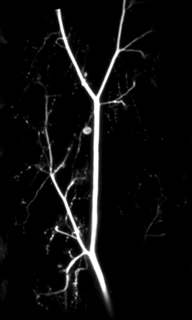
An example of crayfish axon
|
Research I use axons at the crayfish neuromuscular junction (NMJ) as a model system to study the excitability of axons and synaptic transmission. Axons typically branch multiple times before making synaptic contact with other neurons. The terminal branches are typically very thin, < 1 mm in diameter, and preclude direct recording with microelectrodes. A unique feature of my research concerns use of a voltage indicator, to enable monitoring of action potential (AP) in fine braches not accessible to microelectrodes. Thus, by combining microelectrode recordings and imaging, my research projects focus on functions of sodium and potassium channels on axonal excitability and the role of these channels on synaptic transmission. Axons at the crayfish NMJ, with their extensive branching, are morphologically similar to those in the mammalian brain. Therefore, the relevance of my research program is to further the understanding basic principles governing information processing in branching axons.
Teaching BI325/NE203: Principles of Neuroscience, Fall semester BI445/645: Cellular and Molecular Neurophysioloogy, Spring semester Laboratory bits and pieces: 1. Replacing arc lamps with high power LED. 2. Design and use of a "pinch" to electrically isolate a segment of axon. 3. BI445/645:
Spike sorting analysis of action potentials and synaptic potentials recorded
simultaneously from the third nerve and a muscle fiber of the ventral
superficial flexor of crayfish. (read
me, Analysis
Example, Analysis
Manual.) � 4. NE203: Earthword lab. (read
me, Manual for
students.) � 5. NE203: Membrane
Excitability Simulation lab: Nernst potential, action potential and all that.
(read me, Manual for students.) � 6. NE_203: Cockroach lab.
(read
me, Manual
for students, video for how_it_works.) |
|
Comments | 24 November 1998 |
|