
Figure 1.1: A cellular network
Future wireless networks will provide ubiquitous communication services to a large number of mobile users ([Sch94], [Cox95], [PGH95]). The design of such networks is based on a cellular architecture ([Lee89], [Goo90], [CiS88], [Cal88], [Ste89]) that allows efficient use of the limited available spectrum. The cellular architecture consists of a backbone network with fixed base stations interconnected through a fixed network (usually wired), and of mobile units that communicate with the base stations via wireless links (see Fig. 1.1). The geographic area within which mobile units can communicate with a particular base station is referred to a cell. Neighboring cells overlap with each other, thus ensuring continuity of communications when the users move from one cell to another. The mobile units communicate with each other, as well as with other networks, through the base stations and the backbone network. A set of channels (frequencies) is allocated to each base station. Neighboring cells have to use different channels in order to avoid intolerable interferences (we do not consider CDMA networks). Many dynamic channel allocation algorithms have been proposed [TeJ91], [JiR93], [DRF95]. These algorithms may improve the performances of the cellular networks. However, for practical reasons, the channel allocation is usually done in a static way. In this work, we will consider only fixed (static) channel assignment.
Figure 1.1: A cellular network
When a mobile user wants to communicate with another user or a base station, it must first obtain a channel from one of the base stations that hears it (usually, it will be the base station which hears it the best). If a channel is available, it is granted to the user. In the case that all the channels are busy, the new call is blocked. This kind of blocking is called new call blocking and it refers to blocking of new calls. The user releases the channel under either of the following scenarios: (i) The user completes the call (ii) The user moves to another cell before the call is completed. The procedure of moving from one cell to another, while a call is in progress, is called handoff. While performing handoff, the mobile unit requires that the base station in the cell that it moves into will allocate it a channel. If no channel is available in the new cell, the handoff call is blocked. This kind of blocking is called handoff blocking and it refers to blocking of ongoing calls due to the mobility of the users. An example of new call and handoff call is illustrated in Figure 1.2.
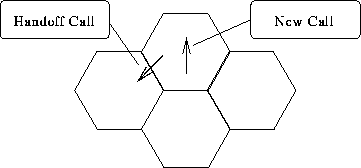
Figure 1.2: New Call and Handoff Call
The motivation for studying the new call and handoff blocking probabilities is that the Quality of Service (QoS) ([LiR94], [Cci92]) in cellular networks is mainly determined by these two quantities. The first determines the fraction of new calls that are blocked, while the second is closely related to the fraction of admitted calls that terminate prematurely due to dropout. Blocking probabilities can be reduced by increasing the capacity of the cellular networks. This can be achieved by applying efficient power control algorithms [Zan92] or by reducing the size of the cells or by increasing the number of channels in each cell [Agn91]. Good power control is not simple and may not always suffice. Reducing cells size necessitates large investments in equipment which of course increase the cost per subscriber. Adding supplementary channels is also a very high cost solution since radio spectrum is a scare resource. Therefore, a good evaluation of the measures of performance can help a system designer to make its strategic decisions concerning cell size and the number of channel frequencies allocated to each cell.
In this work we present a model that captures the differences between new call blocking and handoff blocking. We consider movements of users along an arbitrary topology of cells. Under appropriate statistical assumptions, the system can be modeled as a multi-dimensional continuous-time Markov chain. Multi-dimensional Markov chains usually don't have a product-form solution and are hard to solve even numerically due to the explosion of their state-space. However, we show that in two asymptotic regimes, i.e., for very slow mobile users and for very fast mobile users, product-form results prevail. For these regimes, we provide expressions for the new call blocking and the handoff blocking probabilities and show the fundamental differences between them for fast mobility.
Next, we introduce an approximation approach that attempts to simplify
the solution of the general multi-dimensional Markov chain. The approximation
is based on the idea of isolating a set of cells and having a simplifying
assumption regarding the handoff traffic into this set of cells. This approach
has been used in [FGM93], [HoR86]
and [McM91] where a single cell is isolated
and it is assumed that the handoff attempts into this cell are characterized
by a Poisson process. The rate of the Poisson process is related to various
parameters of the system such as blocking probabilities, mobility of the
users, etc. As is shown in [HoR86], when
no priority is given to handoff call attempts over new call attempts, no
difference exists between these call attempts. In other words, due to the
PASTA (Poisson arrivals see time-averages) property, the handoff and the
new call blocking probabilities are identical. In the new approximation
that we introduce, we isolate a group of cells and make no approximations
regarding the handoff traffic between the cells in the group. The handoff
traffic into cells of the group from cells outside the group is approximated
by a Poisson process. It will be shown that a group of three neighboring
cells is enough to differentiate between handoff call attempts and new
call attempts. Thus, the underlying Markov chain won't be too complex and
results may be easily obtained for any parameters of the system.