Victor Manfredi ...studies the comparative grammar of the Benue‑Kwa
languages of the Niger‑Congo family, and several indigenous cultures of the southern 9ja (or Nàìjá) area. Since 1980 he has taught about these
subjects, mostly as a glorified temp (sounds nicer in Russian: kontráktnik), at a dozen universities in Nigeria, Europe and North America. At BU he has offered Ìgbo and Yorùbá (1993‑2000, 2006‑07), Syntax2 (1999‑2000) and Morphology
(2006‑07) and served on six doctoral committees in syntax (defended in 1996, 1997, 2004,
2007, 2012, 2013
plus one each in musicology ( 2014 = 2021) and history ( 2020). He is currently a research affiliate in BU African Studies Center ( contact information).
In solidarity with the democratic struggle:
https://search.proquest.com/docview/1556761003/abstract
logo:
Zakari Ahmadu (2012)
This movement evokes a "temporary autonomous zone" such as became known in Cairo 2011
and Kyiv 2014 by the Persian>Ottoman term mīdān/maidan etc. denoting open public space.
Update 1 August 2024: #EndBadGovernanceInNigeria
[surveillance-free link]
(or on second thought, how about "#BeginGovernanceInNigeria" — ?)
My work is accessible via these links:
I do not have any (anti-)social media accounts — see sidebar. The following quotes inform my general attitude:
Se noi fossimo immortali saremmo immorali, perché il nostro esempio non avrebbe mai fine, quindi sarebbe indecifrabile, eternamente sospeso e ambiguo. … O esprimersi e morire o essere inespressi e immortali, dicevo.[ translation]
Under the banner of progress, products have been uncritically adopted or even imposed on users — in past centuries with tobacco and combustion engines, and in the 21st with social media. For these collective blunders, we now regret our involvement or apathy as scientists, and society struggles to put the genie back in the bottle.
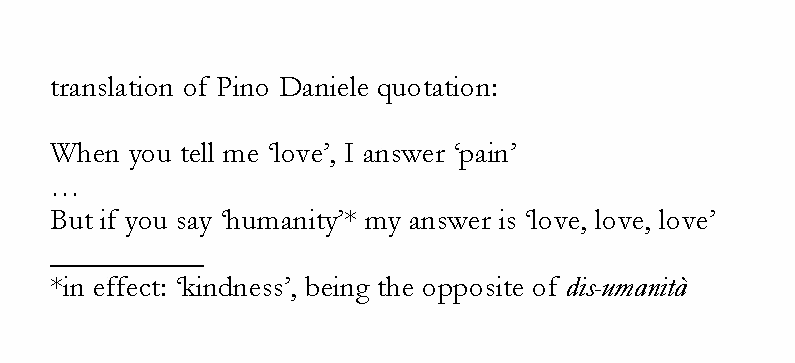
Chi me dice ammore, rispongo dulore … Chi me dice umanità, rispongo ammore, ammore, ammore[ translation]
We do not want wahala, but if you bring wahala, then no wahala. Love and light.
By an 'intelligentsia' — a Russian word, let it be noted — I am speaking not of what we call 'intellectuals' today who are well
ensconced in universities, but [of] a footloose network of writers, artists, poets and professionals of all sorts, even actors (who formed an
exceptionally close and visible community in cities such as Paris during the 18th and 19th centuries). Their absorption in recent years into the modern
university system, with its many emoluments, has been one of the most costly blows to the development of present-day revolutionary movements.
The epistemological question for the social sciences was and has always been where its practitioners would stand in the battle of the two
cultures. … Some of them pushed hard to be part of the scientistic camp, and some insisted on being part of the humanistic camp. … It is possible
that the new epistemologically centripetal tendencies of the structures of knowledge may lead to a reunified epistemology (different from both of the two
principal existing ones) and to what I think of, perhaps provincially, as the 'social scientization of all knowledge'.
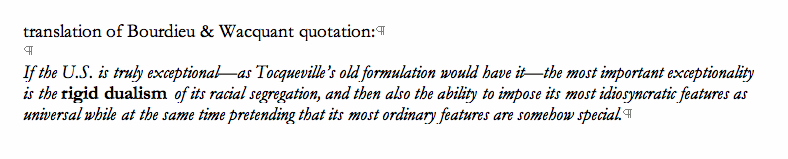
Si les États-Unis sont réellement exceptionnels, selon la vielle thématique tocquevillienne, c'est avant tout par leur
dualisme rigide des divisions de l'ordre racial. C'est plus encore par leur capacité d'imposer comme universel ce qu'ils ont de plus
particulier tout en faisant passer pour exceptionnel ce qu'ils ont de plus commun.[ translation]
Subjectivity, for any sociologist, is always socially determined. … It's based on a theory which says that we live in a society
in which some things which seem to be comprehensible to us are not really, and some things which seem to be incomprehensible to us are really comprehensible.
If racecraft is unlike witchcraft, then lifting from us what Appiah calls its "burdensome legacy" becomes easy lifting. … But if racecraft is like
witchcraft, then repetition can do no more than transmute the scientific statement into the ritual drone of a mantra.
Ironically, as the basis for a politics, antiracism seems to reflect, several generations downstream, the victory of the postwar psychologists
in depoliticizing the critique of racial injustice by shifting its focus from the social structures that generate and reproduce racial inequality to an ultimately individual,
and ahistorical, domain of "prejudice" or "intolerance".
Stalked by a highly disciplined and militant Christianity, the Americas adopted popular music as an underground religion that found its
cathedrals in the communal sites of dancehalls, ballrooms and the street, publicly sharing an agenda of ideas that did not seem religious to the Western
mind at all: animism, polytheism, political satire, transcendence through sex and a secular humanism indistinguishable from all of them. …
The historical memory of a bad colonial inheritence was embedded in the leisure-form, and had to be continually exorcised…
While it is good and commendable to record and document fading traditions, and in some cases this is absolutely necessary to avert total
loss of cultural wealth, the greater goal must be that of safeguarding diversity in the world of people.
Studying sideways, as a public anthropologist, presents a whole different set of challenges than studying down.
[I]ntellectual dissidence is part of the architecture of anthropology.
This is not to say that African culture is any less cultural than say, French or British culture, but that it is harder to render invisible
the politics of African culture. "Africa" is still a site of contention, as we can tell when we note that its scholars, like those of the Middle East, are put
into categories based on the old imperialist politics… A set of alliances or intellectual formations thus connects the English work of Basil
Davidson with the politics of Amílcar Cabral for example to produce oppositional and independent scholarship.
The powerful need nothing from you but to parrot their propaganda. The powerless, on the other hand, often cause as much trouble as they suffer.
Their arguments and discourses are often as brittle as their positions in society and their diminishing chances of safety and survival. Taking their side, therefore,
even as an experiment, is a catalyst for deeper reflection, deeper investigation, deeper analysis and imagination.
I realized that if everyone who had nothing to say didn't, there would be no Modern Language Association.
There is a strong sense of communitas in the air — it is not at all like identity politics — we need a new word for it… They want to read. They want to be with open communities of people of very different ideas.
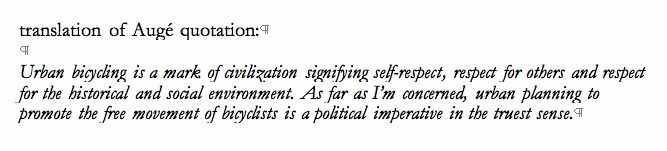
L'uso della bicicletta in città è un segno di civilità che significa rispetto di sé e degli altri, ma anche
dell'ambiente storico‑sociale. Pianificare lo spazio per favorire la circolazione dei ciclisti è per me un imperativo politico, nel senso
più alto del termine. [ translation]
Cependant, la richesse ou la complexité des tableaux de correspondance que nous avons donnés avec cet imbroglio d'un même saint pour
plusieurs orisha et de plusieurs [ saints] pour le même [orisha] , peut provoquer un malaise. N'existe-t-il pas un fil conducteur qui nous permette de mettre
tout de même un peu d'ordre dans le chaos d'identifications contradictoires? [ translation]
We've got lots of theories… We just don't have the evidence.
[ P] repare to be lucky… Columbo… an untidy, seemingly distracted detective… solved cases by poking
around in a practiced but random fashion and stumbling in the direction of a solution. That's how it's done.
[ N] on la teoria atomistica spiega la storia umana, ma viceversa…[ translation]
Guarda le cose anche con gli occhi di quelli chi non le vedono più![ translation]
Es una de las paradojas más tristes de mi vida: casi todo lo que he escrito lo he escrito para alguien que no puede leerme, y este
mismo libro no es otra cosa que la carta a una sombra.[ translation]
Héctor Abad Faciolince, El Olvido que seremos [publisher page] ISBN 9584215000,
Editorial Planeta, Bogotá, 2006, p. 22
He called us spineless, so we developed spines.
But who are the terrorists? Are we the terrorists or are they the terrorists?
…[S]ometimes it's not clear.
Anthony Dominick Benedetto a.k.a. Tony Bennett, radio interview, 20 September
2011
Who has the right to have rights?
Mahmoud Khalil, 18 March 2025
paraphrasing H. Arendt, "The decline of the nation-state and the end of the rights of man"
( The Burden of Our Time, 266-98. Secker & Warburg, London 1951), p. 294
The violence, the refugees, the deportations, the gangs, the evangelicals — the United States government created all this and left Salvadorans with a twisted society. If we question our own actions, perhaps we can make a difference.
Tribalism is attractive to politicians because in many ways it is easier than democracy. … Self-harm and self-pity form a feedback loop of endlessly renewable political energy. And this perpetual motion machine is also driven by revenge.
… The phrase "identity politics" is a misnomer. Tribal politics do not in fact deal in collective identities, which are always complex, contradictory, multiple and slippery. They reduce the difficult "us" to the easy "not them".
… The opposite of progressive hope is not realism. It is paranoia.
The spreading of a virus is not dissimilar to the spreading of political extremism. Many Italians have a way of living and thinking that under normal circumstances
seems harmless: we are rather certain that we are safe, until the day when we wake up and see Mussolini standing on a balcony surrounded by a crew of adoring people. You don’t realize
it until it happens, and, when it does happen, it will often take a war to get rid of it. We started off sending jokes about the coronavirus, and now here we are, with the Italian Army
transporting caskets across the country because crematoria in the worst-hit areas are overwhelmed.
Marco Malvaldi, New Yorker [firewall suspended], 5 April 2020
This is going to be great television.
I'm sorry I don't have a plane to give you.
I'm saying, when a piece of wood has a hinge, you begin to suspect it's a door.
[O]bviously there's a lot going on in our country right now with things — like, everything, yeah.
Pueblo de Italia, un hombre te destroza: repudia su dictamen con un gesto infinito.[ translation]
[W]hat does the [b]illionaire and the general and the priest — what do they actually have in common? … [T]he coalition worked incredibly well, and the answer I submit that they have in common is they're anti-communist…
[ L] a mafia… insorge nel pieno dello Stato.[ translation]
The CDC could have stopped the tide of misery and pestilence that is about to devastate American health and security as our national immunization program is murdered by a psychopath with a brainworm and an apparent death wish for all American children. But they can't, because Kennedy effectively murdered the CDC.
TL: DR marketising higher education is undesirable, and what is happening in unis right now is a product of decades of devaluing education as a good and recasting it as a product.
[T]he growth of endowments as the financial engine for most higher-education institutions has also helped warp the culture of these schools. …
[H]igh-net-worth individuals… support… research that can be translated into intellectual property from which they can profit, or chairs in areas of study
that reflect well on their identity. …[A]dministrators are guided by the same playbook: First, invest in fundraising and development that would be attractive
to billionaires looking for philanthropic opportunities to avoid taxes. Second, leverage your assets by taking on bond-funded debt for new buildings. Third, shrink your workforce
down to the bone by reducing the number of tenured faculty positions, outsourcing food and cleaning services, and paying graduate student workers as little as possible. Then,
get rid of unprofitable departments in the name of productivity. Finally, establish and copiously reward administrators who will execute those policies with alacrity.
As universities are beaten into the shapes dictated by business, so language is suborned to its ends. We have all heard the robotic idiom of management, as if a button had activated a digitally
generated voice. …
Education — of which creative writing is just one strand — gives its participants material to think with, and ways of reading, thinking and speaking. It helps fashion 'the
country of words' as Mahmoud Darwish puts it, where we travel and dwell.
The proposed visions of AI make it clear that a primary motivation for these tools emerges from the impulse to produce more science, more quickly and more cheaply. Given evidence that increased publications stagnate the generation of new ideas [fnn],
considering the epistemic risks of AI provides us with an opportunity to reflect on whether this level of productivity — one demanded by academic and publishing institutions — is one that researchers desire and one that benefits the collective endeavour of scientific understanding [fnn].
When we use generative AI, we consent to the appropriation of our intellectual property by data scrapers. We stuff the pockets of oligarchs with even more money. We abet the acceleration of a social media gyre that everyone admits is making life worse. We accept the further degradation of an already degraded educational system.
We agree that we would rather deplete our natural resources than make our own art or think our own thoughts. We dig ourselves deeper into crises that have been made worse by technology, from the erosion of electoral democracy to the intensification of climate change. We condone platforms that not only urge children to commit suicide,
they instruct them on how to tie the noose. We hand over our autonomy, at the very moment of emerging American fascism.
Appealing as it may be to view science as occupying a privileged epistemic position, scientific communication has fallen victim to the ill effects of an attention economy.
More than a few independent studies/reports have shown that social media (esp Twitter) selectively amplif[y] false information. … It's important to realize that an engagement-optimized platform will
naturally tend to do this — false information is infinite and not constrained by reality in its ability to capture our attention. True information doesn't stand a chance. … Every single time a profitable tech has a
core issue/externality, the industry will pivot towards expecting those impacted to fix it.
[W]hen you have cognitive automation — something that helps you think less — you inevitably think less.
"Once you go automatic, target generation goes crazy."
Capitalists tell you that competition is important to improve quality but then will also tell you consolidation is essential to improve quality They don’t care about quality though just extraction That’s what happened today. The coding error was a mistake. The rest? No
Politics is the thing we do to keep ourselves from murdering each other. In a world where everyone uses computers and software, we need to exercise democratic control over that software.
So let me get this right: in exchange for the maps you will give away your democracy, the mental health of your children, your own mental health – for a map? I will get you a map!
Zuckerberg's ambition is to insert his billions of Facebook non-gamer users into a Steam-like digital social economy — complete with a top-down platform currency that he controls.
How can I resist the parallelism with a digital fiefdom in which Zuckerberg dreams of being the techno-lord? … Central bank money has replaced private profit (as the system's main fuel and lubricant)
and digital fiefdoms/platforms have become the realm in which value and capital are extracted from the majority by a tiny oligarchy.
In medieval feudalism, peasants worked land they didn't own, under rules they didn't choose, for lords who profited from their labour. Today we work for attention, on platforms we don't own, governed by algorithms we don't control. … That's digital feudalism.
Silicon Valley ideology is using private equity to buy a new marketplace, flood[ing] it with capital to flush out competitors and us[ing] economic dominance to eviscerate working conditions and the cost of labour before jacking up
the prices again, this time with the surplus all going to investors. It's hyping specific technologies as universal, structural game-changers in accelerating hype cycles designed to fleece their marks quickly enough to drive growth and cash out before
most people realise the technology simply doesn't work as they were told. Bonus points for damaging trusted institutions (crypto) or labour (AI) along the way.
AI is the narrative. It’s not the technology. Surveillance and infrastructure are the material conditions. … OK, say we have radiological detection that actually is robust. But then it gets released into a health care system where it's not used to treat people, where it’s used by insurance companies to exclude people from coverage—because that’s a business model. Or it's used by hospital chains to turn patients away. How is this actually going to be used, given the cost of training, given the cost of infrastructure, given the actors who control those things?
Framing GenAI as a battle between teachers and students is a red herring. Students and educators are on the same side. The real opposition are the data extraction firms and brokerages and their allies among the managerial class. … Or better yet: make GenAI about an assault on civics. Because if you are selling a product that necessarily attempts to con one person into believing they are engaging with another person when they are not, you're not just ruining education. You're dismantling society's foundations in social trust.
I pretend to teach; you pretend to learn; everyone gets an A. This is partly an LLM problem and partly an organizational problem. The LLM makes life much, much easier for everyone who wants to just pretend, and much, much harder for everyone who doesn't.
One may get a remarkable semblance of a language like English by taking a sequence of words, or pairs of words, or triads of words, according to the statistical frequency with which they occur in the language, and the gibberish thus obtained will have a remarkably persuasive similarity to good English.
Today, the financial sector operates by mafia rules; it is not that the mafia has become financialised, but that the financial sector has become mafia-like.
Si può concepire uno sviluppo senza progresso, cosa mostruosa che è quella che viviamo in circa due terzi d'Italia; ma in fondo si può concepire anche un progresso senza sviluppo, come
accadrebbe se in certe zone contadine si applicassero nuovi modi di vita culturale e civile anche senza, o con un minimo di sviluppo materiale. … È in corso nel nostro paese, come ho detto, una sostituzione di valori e di modelli, sulla quale hanno avuto grande peso i mezzi di
comunicazione di massa e in primo luogo la televisione. Con questo non sostengo affatto che tali mezzi siano in sé negativi: sono anzi d'accordo che potrebbero costituire un grande strumento di progresso culturale; ma finora sono stati, così come li hanno usati, un mezzo di spaventoso
regresso, di sviluppo appunto senza progresso, di genocidio culturale… Qualche analogia il nostro processo di industrializzazione degli ultimi dieci anni con quello tedesco di allora ce l'ha: fu in tali condizioni che il consumismo aprì la strada, con la recessione del '20, al nazismo.
[ translation]
the location of this page is https://people.bu.edu/manfredi
last updated 20 September 2026
|