Exploring the subatomic world
                                       Discovery is the ability to be
                                       puzzled by simple things.

                                       Noam Chomsky
Electrons, protons, and neutrons
After a great dedicated effort of exploration, involving hundreds of men and women over hundreds of years, there was overwhelming evidence that all of the matter in the world around us is made of atoms. That simple fact is now widely accepted. It is something most children are taught in school by the time they are ten years old. And yet, for thousands of years, it was a controversial idea that was argued for and against by some of the greatest minds in human history.There are relatively few atoms, and an apparently infinite variety of physical compounds that can be built from them. This is a beautiful example of what we have come to call an emergent property - when rich and complex behavior results from the repeated application of a few, simple rules. In chemistry, we find that a few simple rules governing the combination of atoms, from a relatively small number of elements, results in a wonderful universe of compounds of varying colors, scents, tastes, textures, densities, strengths, viscosities, and reactivities.
Another, and perhaps even more remarkable, example of an emergent property is the wide variety of atomic character that emerges from simple combinations of only three, subatomic particles - protons, neutrons, and electrons.
                 Elementary properties of subatomic particles

        particle name          mass               charge           spin
          electron      0.000911 X 10⁻²⁷ kg    - 1.60 X 10⁻¹⁹ C      1/2
          proton        1.672623 X 10⁻²⁷ kg    + 1.60 X 10⁻¹⁹ C      1/2
          neutron       1.674929 X 10⁻²⁷ kg           0             1/2
          neutrino               ?                   0             1/2
How did we come to know that all atoms are made of a particular combination of
these three basic particles? A few key experiments,
carried out a short time after the existence of atoms became widely accepted
at the turn of the twentieth century, led to our current knowledge
of the structure of the atom.
Stoney and the electron
G. Johnstone Stoney began his study of the electron and its properties long before the now more famous experiments of J. J. Thomson and Robert Millikan. Stoney's method for the determination of the electron charge is one that is quite powerful and can be used today to determine the charge on a single electron with little more than water, wires, a battery, and Avogadro's number.Stoney's method is beautifully simple. He knew that if he inserted two electrodes into a bowl of water, each under an inverted glass, by applying a voltage across the wire he could cause the water, H2O, to separate
2 H2O(l) → 2 H2(g) + O2(g)
Moreover, he could collect the pure hydrogen gas, H2, at one electrode, and pure oxygen gas, O2, at the other electrode. By measuring the amount of gas collected, and knowing Avogadro's number, he could determine the number of molecules of water that had been dissociated.What role did the wire play? Why was voltage applied? It turns out that under one glass, there was the reaction
4 H+(aq) + 4 e- → 2 H2(g)
while under the other glass, there was the reaction2 H2O(l) → 4 H+(aq) + 4 e- + O2(g)
If we add these two half reactions together, we recover the overall reaction2 H2O(l) → 2 H2(g) + O2(g)
That is a special sort of electrochemistry that we will study in detail later. For now, we just need to know that the two half reactions can occur in different places as long as those two places are connected by a wire so that the electrons, products in one reaction, can be transported to the other reaction, where they are reactants.Stoney knew that if he produced 2 grams of hydrogen gas, he had created one mole of hydrogen gas, which was Avogadro's number of hydrogen molecules. To create one hydrogen molecule, two electrons had to flow through the wire. Therefore, he knew that
total # electrons = ne = 2 x number of H2 molecules produced = 2 x NA x nH2
where nH2 is the number of moles of hydrogen gas produced and NA = 6.022 127 x 1023 mol-1 is Avogadro's number of hydrogen molecules in a mole of hydrogen gas.Stoney also knew that if he could measure the current, I, that flowed, and how long the current flowed in time, t, he could determine the total amount of charge of the electrons that flowed through the wire
total charge passed = I x t = ne e
Therefore, knowing the current, the time it ran, and the volume of hydrogen gas produced in that time, he could determine the absolute magnitude of the charge on the electron, e.
 Now that is truly remarkable. He performed nothing more than
a bench top experiment using water, wire, a battery, an ammeter, a measuring
cup (to figure out the volume of the gas by the volume of the water
displaced), and a watch. The result was nothing less than a direct
measurement of one of the few most important fundamental physical constants -
the charge on the electron!
Try to devise an experiment of similar simplicity to measure the speed
of light, c, or Planck's constant, h, or Boltzmann's constant, kB.
Good luck!
Now that is truly remarkable. He performed nothing more than
a bench top experiment using water, wire, a battery, an ammeter, a measuring
cup (to figure out the volume of the gas by the volume of the water
displaced), and a watch. The result was nothing less than a direct
measurement of one of the few most important fundamental physical constants -
the charge on the electron!
Try to devise an experiment of similar simplicity to measure the speed
of light, c, or Planck's constant, h, or Boltzmann's constant, kB.
Good luck!
You can do this experiment yourself and find the charge on the electron of 1.6 x 10⁻¹⁹ C which is the currently accepted value. It isn't easy to get a more accurate measurement using this method, but two significant figures is not bad at all! Stoney did this experiment and arrived at a value for the charge on the electron of 1.0 x 10⁻¹⁹ C. Not so great. As a result, when we think of the charge of the electron today, we think of Thomson and Millikan. What went wrong for Stoney? It turns out that his method is just fine, but the value of Avogadro's number, essential for converting his moles of hydrogen gas into numbers of individual electrons, was poorly known at the time. The value that Stoney used was NA = 1.0 x 1024 mol-1 and that led to his precise but inaccurate determination of e.
Thomson, the electron, and television
Some time later, Thomson performed some key experiments using the electromagnetic force that had become understood in the previous century. It was known that if a voltage, V, was applied across two metal plates separated by some distance, d, between the plates there would be an electric field of magnitudeE = V / d
If we put a charge, q, between the plates - in the electric field - the charge will feel a force of magnitudeFelec = q E
and the applied force will cause the charge to move. That is what we expect. Like charges repel and unlike charges attract.
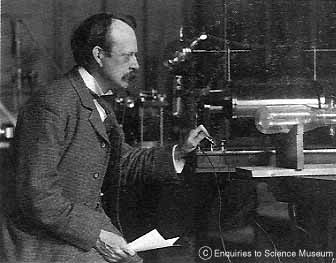 So Thomson knew that the electrical force
could be used to accelerate charged particles. Using this idea he
invented the cathode ray tube.
Here's how it works. He would heat some metal called a
cathode and it would produce charges. Thompson
then passed some of those charges between a set of charged plates to
accelerate them in a particular direction using the electrical force.
To detect the particles, the cathode ray, he aimed it at a
phosphorescent screen so that when the particles of the beam
hit the screen, it would glow.
So Thomson knew that the electrical force
could be used to accelerate charged particles. Using this idea he
invented the cathode ray tube.
Here's how it works. He would heat some metal called a
cathode and it would produce charges. Thompson
then passed some of those charges between a set of charged plates to
accelerate them in a particular direction using the electrical force.
To detect the particles, the cathode ray, he aimed it at a
phosphorescent screen so that when the particles of the beam
hit the screen, it would glow.
Now here's the clever part. Once he had the beam of charges moving in a particular direction, he passed the beam, the cathode ray, through two more plates arranged perpendicular to the first two plates. Depending on the charge on the particles, and the size of the electric field - the voltage across the plates and the distance between them - the cathode ray would be deflected up or down by some amount. If he put another set of plates perpendicular to both the first and second sets, he could also move the particle beam left or right. Thomson could "aim" the cathode ray beam up or down, and left or right, by varying the voltages across the sets of plates!
Does this device sound familiar to you? It should, if you've ever watched a television. The television's tube is a cathode ray tube. The pattern on the screen is made by creating a cathode ray, a beam of electrons, and then passing the beam through charged plates that direct the beam to particular spots on the screen. The voltage on the first set of plates moves the beam up a bit, then the voltage on the second set of plates moves it a bit to the left. The television screen is the phosphorescent plate that glows when the beam hits it. The television can make many, many spots in a given pattern very, very quickly. So the beam paints the picture, spot by spot, using Thomson's cathode ray tube technology. Fantastic!
It turns out that Thomson could do something even more remarkable with his cathode ray tube. He knew Newton's equation of motion that said that the force on a particle is equal to the particle's mass times its acceleration. That means that when the charged particle moves between the plates and feels a force, Felec, acting on it, it will accelerate by an amount proportional to the force divided by the mass. That makes sense. If you push a light ball with the same force that you push a heavy ball, the light ball will accelerate more. It will be deflected more.
Suppose that the charged particle spends a time, t, moving through the plates. Then it will leave the set of plates deflected up or down by an amount
δ = (e / 2 me) E t2
Since he knew the voltage and the distance between the plates, he knew the electric field, E. He knew how much the spot on his screen was deflected. He also knew the time the beam spent between the plates, t. Thomson had to be clever to learn how long a particle spent moving between the set of plates. He did that by knowing the particle's velocity and the distance between the plates. By dividing the length of the plate by the velocity, he knew the time spent between the plates.Knowing all those things, he could figure out the ratio of the charge of the electron, e, to the mass of the electron, me, as
e / me
That's not too bad! And more than determining this ratio of fundamental constants, Thomson had invented a fantastic tool for the exploration of the atomic and subatomic world. He received the Nobel Prize in Physics in 1906 for his discovery of cathode rays.Thomson and the mass spectrometer
We've already seen that we could use Thomson's cathode ray tube to build a television or a computer monitor. Here's something else that we can make using the same ideas.Thomson knew that the path of a moving charge would bend as it passed through a magnetic field. If a charge, q, moves through a magnetic field, B, with a velocity, v, there will be a force on the charge. Suppose the magnetic field is pointing upward in the z-direction and a positive charge, q > 0, moves forward with a velocity, v, through the magnetic field in the x-direction. Starting from Ampere's law, it can be shown that the force will have a magnitude
Fmag = (q v / c) B
Here's the amazing part - the force pushes the charge in the y-direction. That's wild, right? But it's the way that it happens.Now there's something important about the fact that when the charged particle is moving perpendicular to the magnetic field, the force is always perpendicular to the direction of motion of the particle and the field. That is true initially, and also as the particle turns due to the force. At every instant, the force will be oriented perpendicular to the particle's direction of motion and the field. As a result, the particle will turn and follow a circular path.
What is the radius of that path? We can determine the radius by realizing that the circular path is created by a balance of the outward centrifugal force and the inward magnetic force
m v2 / r = Fcent = Fmag = (q v / c) B
The radius of that circular path isr = m v c / q B
If the radius is measured, the ratio of the ion's mass to chargem / q
can be determined.Thomson's brilliant invention led to the invention of the device known as the mass spectrometer. That device takes an atom, ionizes it, and then passes it through a pair of charged plates that generate an electric field. The electric field accelerates the charged atom so that when it passes from the plates, it has a particular speed and a particular direction - a particular velocity. The charged atom then moves through a magnetic field that turns the atom in one way or another, depending on the atom's charge and mass. Let's see how that works in more detail.
In Thomson's device, the particular velocity that a charged atom obtains will depend on its charge and mass and just how it enters the plates. That means that in a beam of charged particles, there will be a variety of velocities. But we can select particles having a particular velocity using a chopper. Think of an ion with a particular velocity that is directed through the magnetic field. The magnetic field has a particular strength and is oriented perpendicular to the beam of ions. Moving through the magnetic field, each ion experiences a force that deflects its path. The degree to which it is deflected is determined by the force on the electron and its mass, me.
According to Newton, for a particle of constant mass the acceleration is equal to the force divided by the mass. The heavier the ion, the less it will be deflected. The lighter the ion, the more it will be deflected. So if we take a soup of atoms and molecules, ionize them, and then pass them through the mass spectrometer, they will all be deflected to one degree or another depending on the charge and mass. Only a few charges are possible - plus an electron or two, or minus and electron or two. So most of the variation in the angle of deflection comes from the variation in the mass. If we detect the various angles, we can then interpret those angle very precisely in terms of the mass of that ion. Thomson's protege Francis Aston received the Nobel Prize in Chemistry in 1922 for his use of mass spectrometry in the study isotopes.
The mass spectrometer is used throughout physics and chemistry. You'd be hard pressed to find a chemistry department that does not have one. It is also used by geologists and environmental scientists, because they need to analyze samples of stuff to find out what the stuff is made of at the level of atoms and molecules. These days it is even used by the biologists! Their molecules are big, but the modern machines can even analyze pieces of DNA in efforts to sequence genes. It is a fabulous tool.
Millikan and electron charge
 Not many years after Thomson's experiments, Millikan took the next step
by determining the magnitude of the charge on the electron, e. He did
that with a clever experiment that starts with a vapor of tiny oil
droplets. Electrons are injected into the dispersion of oil droplets
and dissolve in the droplets. Each droplet will then have zero, one, two,
or some other number of electrons attached to it. Millikan then passed
the droplet through an electric field that he could control. He knew
that the downward force of gravity on the droplet would be the
force of buoyancy
Not many years after Thomson's experiments, Millikan took the next step
by determining the magnitude of the charge on the electron, e. He did
that with a clever experiment that starts with a vapor of tiny oil
droplets. Electrons are injected into the dispersion of oil droplets
and dissolve in the droplets. Each droplet will then have zero, one, two,
or some other number of electrons attached to it. Millikan then passed
the droplet through an electric field that he could control. He knew
that the downward force of gravity on the droplet would be the
force of buoyancy
Fgrav = -(moil - mair) g
in terms of the constant of gravitational acceleration, g. The force is negative to indicate that it is in the downward direction.How can we know the mass of the oil forming the droplet? We can use the simple principle that the mass of an object is equal to the object's volume times its density. The mass of the oil drop can be determined by knowing the density of the oil, ρoil, and the radius of the droplet, rdrop, as
moil = ρoil Vdrop = ρoil (4 / 3) π rdrop3
The mass of the air displaced by the oil is found in the same waymair = ρair Vdrop
Millikan used a pair of oppositely charged plates to create an electric field, E, and an upward force on the dropletFelec = ne e E
where ne is the number of electrons attached to the droplet. If the magnitude of the force of gravity was just equal to the magnitude of the electrical forceFelec = - Fgrav
the droplet would stop moving. That would mean thatne e = (moil - mair) g / E
Millikan could measure the size of the droplet, with a microscope, and determine its mass. He also knew the magnitude of the applied electric field. Therefore, he could compute the total charge on the drop, ne e, which was the fundamental electron charge multiplied by some whole number.Millikan determined the charge on many, many, many droplets. He found many possible ratios of whole numbers. Analyzing that data, he was able to determine e itself, a miraculous achievement for which he received the Nobel Prize in Physics in 1911.