TEACHING
AS 203: Principles of Astronomy II
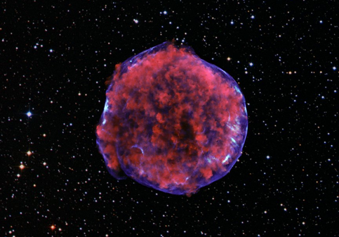
This course is an introduction to stars, galaxies, and cosmology. It is intended for students majoring in Astronomy or Astronomy & Physics, or other students with a strong mathematical background. It is normally taken during a student’s first year. I teach this course most spring semesters.
Image: Tycho’s supernova remnant (X-ray: NASA/CXC/Rutgers/K.Eriksen et al.; Optical: DSS)
AS 312: Stellar and Galactic Astrophysics
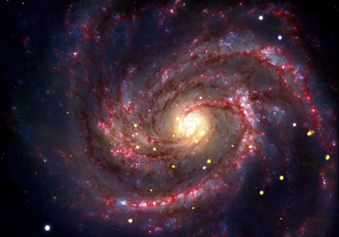
This course provides an introduction to stellar and Galactic astrophysics. Topics covered include light and the physics of radiation, stellar atmospheres, stellar interiors, star formation and evolution, compact objects (white dwarfs, neutron stars, and black holes), the interstellar medium, and the structure and kinematics of the Milky Way Galaxy. This is normally taken in a student’s second year of undergraduate study.
Image: SN 1979C (X-ray: NASA/CXC/SAO/D.Patnaude et al.; Optical: ESO/VLT; Infrared: NASA/JPL/Caltech)
AS 701: Introduction to Astrophysics
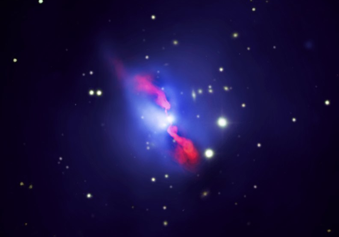
This course provides a general introduction to astrophysics for incoming graduate students. It is intended to introduce students with physics backgrounds to a wide range of astrophysical topics, and to fill in gaps for students who have more of an astrophysical background. Topics covered include light, stellar atmospheres, stellar interiors, star formation and evolution, compact objects, ISM, the Milky Way, galaxy formation and evolution, the large-scale structure of the Universe, and cosmology.
Image: Hydra A (X-ray: NASA/CXC/U.Waterloo/C.Kirkpatrick et al.;Radio: NSF/NRAO/VLA; Optical: CFHT/DSS)
AS 710: Observational Techniques
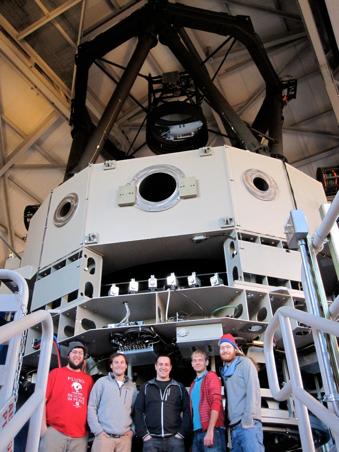
This graduate-level course covers modern observational techniques with a focus on optical observations. Topics include: telescopes, light detection, statistical methods, signal-to-noise calculations, photometry, optics, instrumentation, CCDs, modern software analysis tools, image processing, proposal writing and science writing. Students use telescopes available at Boston University as well as those at Lowell Observatory in Arizona.
Image: Students from the Fall 2013 AS 710 course in front of the Discovery Channel Telescope in Happy Jack, AZ.