Broader Impacts

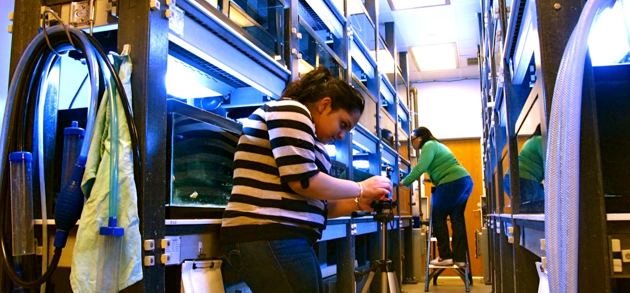
The Buston Lab has active, NSF supported, collaborations with the Harrison Lab at Cornell University, the Webb Lab at Colorado State University, the Warner Lab at the University of California at Santa Barbara, the Paris Lab at the University of Miami and the Webb Lab at the University of Rhode Island. We train postdocs and graduate students in animal behavior, sensory biology, marine ecology, scientific diving, molecular lab work, population genetics, coupled biophysical modeling, and mathematical population modeling. Our trainees fare well, both in terms of publications and success in the job market. Finally, we incorporate the findings from our research into the courses we teach. e.g., BI582 Integrative Marine Ecology.
Integration of Research and Teaching
Since opening in January 2011, the Buston Lab has mentored 18 undergraduates from a diversity of backgrounds. We have well-defined three-year mentoring plan for these students: as sophomores, they learn to maintain the saltwater aquarium system and take care of the fish, through hands on experience working with the lab manager; as juniors, they assist with ongoing research projects in the Lab, and receive peer-peer mentoring; as seniors, they design, execute and write-up their own research project, and give peer-peer mentoring. You can read more about the students’ experiences in the Buston Lab on their independent blog.
Every year, we collaborate with Brandy Freitas from Science Club For Girls, providing internships in the lab for one or two high school girls. The joint aims of the Buston Lab and SCFG are to get the students excited about science, make them aware of opportunities in science, and increase their self-belief in their ability to do science. During the internship, the girls participate in every stage of the scientific process from coming up with a question, to collecting and analyzing data, to presenting their results. You can learn more about the impact of Science Club For Girls here and the experience in the Buston Lab here.
Broadening Participation of Underrepresented Groups
The Buston Lab works with the media to ensure accurate dissemination of the results of our research projects. Our research has been featured in the New York Times, on National Public Radio, by the BBC, CNN, and, of course, by The Naked Scientists. Our recent article in American Scientist was nominated for an APEX Award for Publication Excellence. You can view a small selection of our work with the media on our media highlights page.
We will be sharing our data and results from our NSF funded projects on larval dispersal and population connectivity with the Belize Fisheries Department, with Dr. Randi Rotjan from the New England Aquarium, and with Dr. Valerie Paul from the Smithsonian Marine Station. Our long-term goal is to do cutting edge science that helps inform Belize’s coral reef monitoring programs, marine reserve network and fisheries management planning.
We are collaborating with Paul McGuinness a Marine Science teacher from the Cambridge Rindge and Latin School. There are two goals of this collaboration. First, we provide an internship in the lab for one student from CRLS each year. Second, we intend to develop a website, in English and Spanish, on the theme of larval dispersal and population connectivity — this will include useful resources for K-12 marine science educators.
Dissemination of Results to Enhance Public Understanding